


The Political System of Pomerania Under the Griffin Dynasty
Initially, the Duchy of Pomerania constituted a patrimonial monarchy governed by ducal law. During the thirteenth century, with colonization and the adoption of Western models (colonization under German law), the duchy transformed into a feudal monarchy, with relations based on feudal law and estate privileges. Following a period of feudal dependence on Polish dukes, the duchy became part of the Empire, which was ultimately confirmed by Emperor Charles V, who granted Bogislaus X the status of an immediate imperial vassal. In the sixteenth and seventeenth centuries, the Pomeranian dukes exercised power through the court and central offices (chancellor, chancery, marshal, national rentmaster) as well as local offices (landvogt, domain administrations).
The Political System of Pomerania Under the Griffin Dynasty
Księstwo pomorskie wyłoniło się z mroków historii jako państwo o dość luźnej strukturze, w którym władza należała do księcia Warcisława. W skład państwa wchodziły związki plemienne (Wolinianie, Pyrzyczanie), a także republiki kupieckie, np. Szczecin czy Wolin. Powiązanie Pomorza stosunkiem lennym z Polską zaowocowało recepcją części wzorców prawnych i organizacyjnych w księstwie, a także konsolidacją władzy książęcej kosztem tendencji odśrodkowych (niezależność republik kupieckich). Podstawą ustroju było prawo książęce, decyzje władcy stanowiły nowe normy prawe, a kraj miał charakter wczesnofeudalnego państwa patrymonialnego. Władza księcia nie była nieograniczona, wpływ na nią miał dwór książęcy, drużyna książęca i możnowładztwo wyrosłe ze starszyzny związków plemiennych, wchodzących w skład księstwa.
The ethnic foundation of the population consisted of Slavic tribes, including the Kashubians inhabiting the areas located east of the Oder, and the Veleti on the western side of the Oder. The main source of livelihood was agriculture, as well as crafts and trade, including maritime trade. The latter was concentrated in proto-urban centers, merchant republics such as Szczecin or Wolin, and ducal strongholds, for example, in Kołobrzeg.
The offices of chamberlain, cup-bearer, sewer, and tribune are known to have existed at the ducal court. In the course of Wartislaw’s reign, the country was divided into stronghold districts (castellanies) with administrative centers located in fortified strongholds that performed defensive functions. The chief territorial official was the castellan, who represented the monarch and administered the stronghold district.
The lack of the principle of primogeniture within the Griffin dynasty formed the basis for the division of the country into smaller dominions whenever inheritance involved more than one of the ducal sons. The first partition took place as early as the mid-twelfth century between the sons of Wartislaw I—Casimir I and Bogislaus I.
With the adoption of Christianity, a distinct estate emerged—the clergy—and following the establishment of the Pomeranian bishopric in 1140, the internal organization of the diocese (parishes, archdeaconries) gradually developed.
Wejście Pomorza w krąg kultury śródziemnomorskiej, co ostatecznie nastąpiło wraz z przyjęciem chrześcijaństwa, wpłynęło także na ustrój polityczny. Szczególne znaczenie w tym miała kolonizacja kraju w XIII wieku. Koloniści z krajów zachodniej Europy przynieśli z sobą nowe rozwiązania techniczne, gospodarcze, społeczne i prawne. Książęta, zainteresowani podniesieniem poziomu ekonomicznego państwa poprzez jego zagospodarowanie, karczunki, osadnictwo, rolnictwo, rzemiosło i handel, sprzyjali upowszechnianiu procesu zwanego kolonizacją na prawie niemieckim (ius teutonicum). Zjawisko to widoczne było nie tylko w napływie osadników, ale przede wszystkim w nowej organizacji społeczeństwa, czego zewnętrznymi efektami były zakładanie wsi i lokacje miast na prawie pisanym (magdeburskim, lubeckim) a także nadawanie przez panujących immunitetów prawnych i ekonomicznych jednostkom i grupom społecznym oraz instytucjom, np. klasztorom.
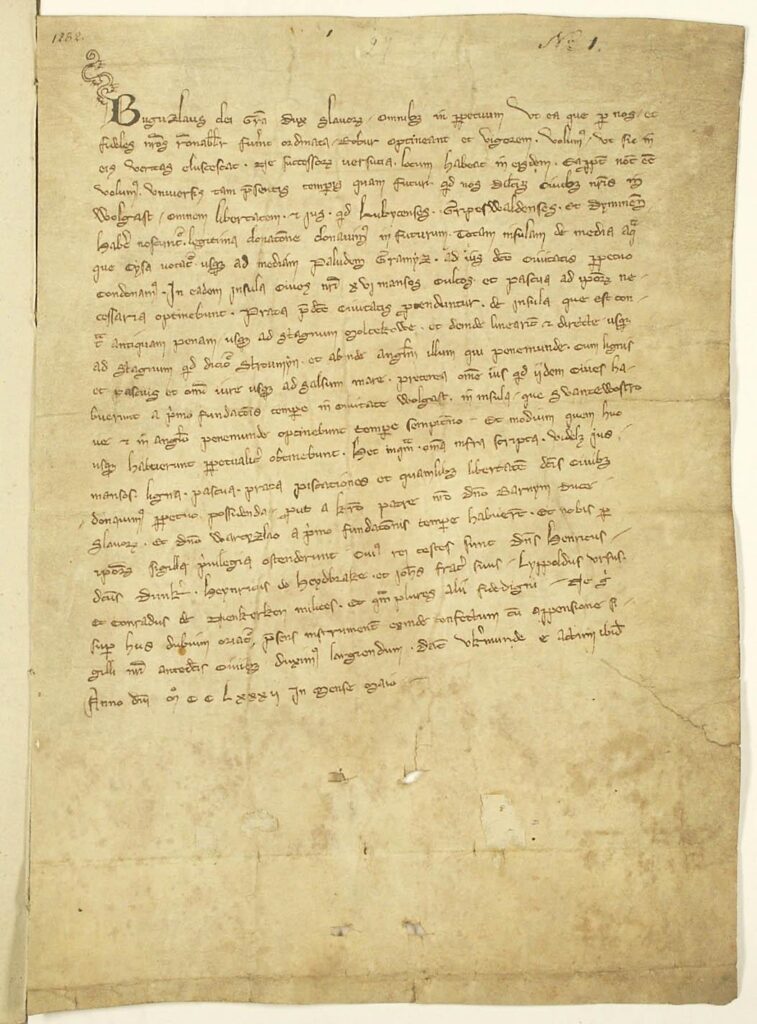
Nowe formy prawne zmieniły także ustrój polityczny księstwa. Z monarchii patrymonialnej przekształciło się ono w feudalne państwo z prawem lennym, będącym głównym wyznacznikiem więzi między książętami a rycerstwem-szlachtą, a także mieszczaństwem i chłopami. W tym nowym ustroju rycerstwo (szlachta), a także miasta stały się stanami dominującymi, z którymi musiał się liczyć każdy panujący. Ponadto duchowieństwo stało się w pełni wyodrębnionym stanem, posiadającym liczne przywileje i majątek. Ukoronowaniem tych procesów było wyodrębnienie się osobnego władztwa świeckiego biskupów kamieńskich w II połowie XIII wieku (ziemia kołobrzeska).
The political transformations brought about changes in the organization of the ducal court, leading to the emergence of the office of marshal, as well as the ducal chancery with scribes and notaries. The office of chancellor in Pomerania is attested only from the mid-fourteenth century.
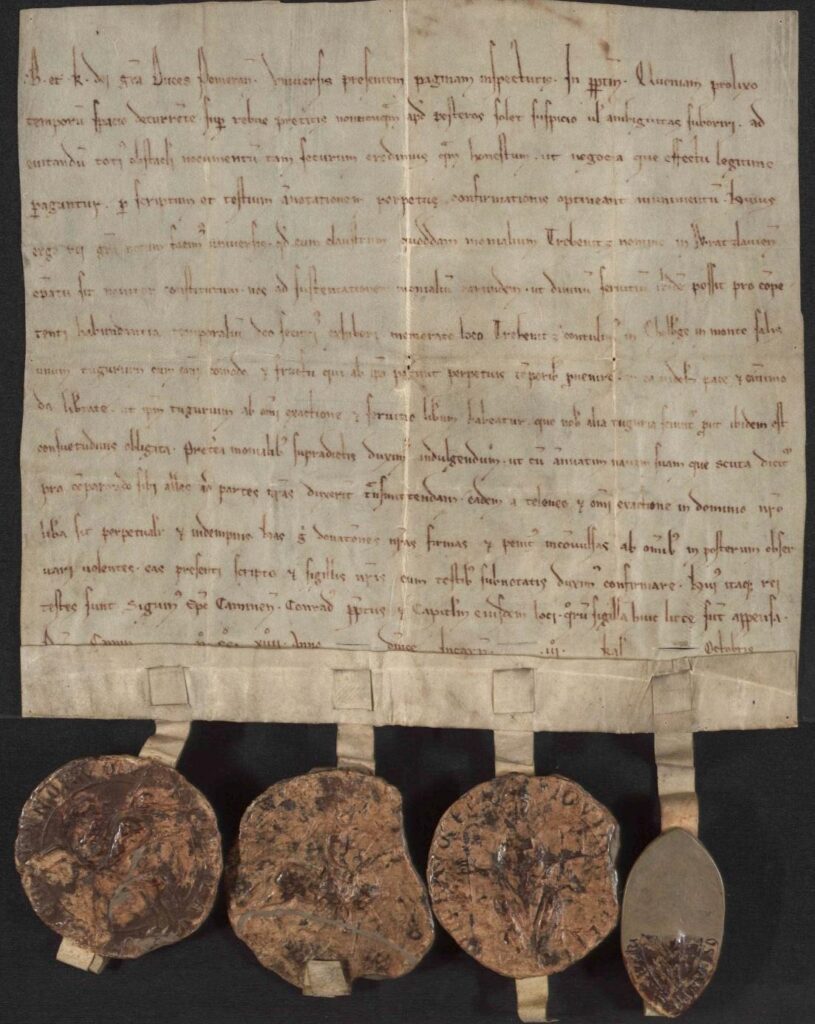
W XIII wieku nastąpił zanik organizacji grodowej i kasztelani. W ich miejsce pojawił się podział księstwa na landwójtostwa, a funkcje militarne od XIII wieku spełniały obwarowania miast lokowanych na Pomorzu oraz budowane zamki. W tych ostatnich często rezydował nowy urzędnik, książęcy – landwójt. Odpowiedzialny był on za bezpieczeństwo wewnętrzne i zewnętrzne, zarząd nad majątkiem książęcym, pobór podatków i danin książęcych, a także sprawowanie w imieniu monarchy sądownictwa w powierzonym okręgu. W przypadku zagrożenia militarnego na wezwanie księcia landwójt zwoływał miejscowe rycerstwo, a także wolnych sołtysów i innych.
These transformations also influenced the political status of the duchy. In the second half of the twelfth century, the political ties with the Polish dukes weakened. As a result, in 1181, Bogislaus I took a feudal oath to Emperor Frederick Barbarossa. Pomerania became part of the Empire as an immediate fief. However, the Pomeranian dukes lost this status between 1225 and 1250, becoming vassals of the margraves of Brandenburg within the Empire.
The division of the Duchy of Pomerania in 1295 between the sons of Barnim I—Bogislaus IV and Otto I—initiated a regional fragmentation of the country that lasted for nearly two hundred years. The unification of the country occurred in the second half of the fifteenth century. In 1478, following the death of Wartislaw X, Duke of Wolgast, Bogislaus X assumed power over the entirety of Pomerania, stretching from Lębork and Bytów to the island of Rügen and the Reknitz River.
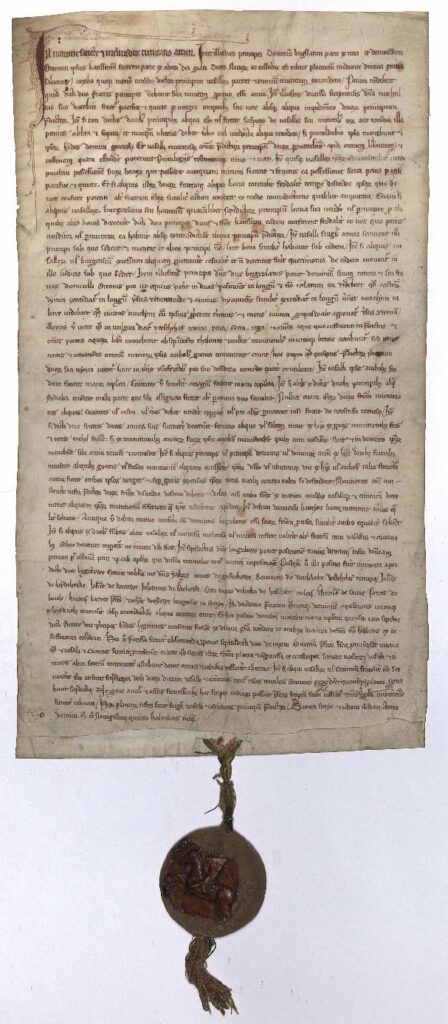
This latter ruler carried out a series of reforms in the state and established a central administration for the entire duchy, with its seat at the castle in Szczecin. It was headed by the chancellor, who was responsible for domestic and foreign policy, as well as the chancery. He also acted as the monarch’s deputy during his absence. Important roles were played by the marshal and the national rentmaster. The latter was responsible for revenue from taxes as well as from the ducal domains. The Court of Appeal (Sąd Nadworny) in Szczecin was also established. The territorial administration underwent restructuring. Due to its distortion at the end of the fifteenth century, the office of the landvogt was restricted to the judiciary. The management of the ducal estates was entrusted to domain administrators, who were supported by rentmasters. The latter were obliged to manage taxes and dues. Furthermore, the competencies of the administrators also included the governance of a strictly defined area of the country, where they represented the person of the duke. Moreover, during the reign of Bogislaus X, estate representation finally took shape. The assembly of the nobility and towns evolved into the Pomeranian parliament (sejm), alongside an estate advisory council to the duke, composed of land councillors. Throughout the sixteenth century, both institutions grew in importance, especially in the face of the financial crises of the Pomeranian rulers. The Pomeranian estates then assumed control over the system of tax collection in the duchies, as well as over excessive state expenditures that the rulers could not cover with revenue from the ducal domains. For the purpose of tax collection and distribution, estate treasuries were established in Anklam (for the Duchy of Wolgast) and in Stargard (for the Duchy of Szczecin).
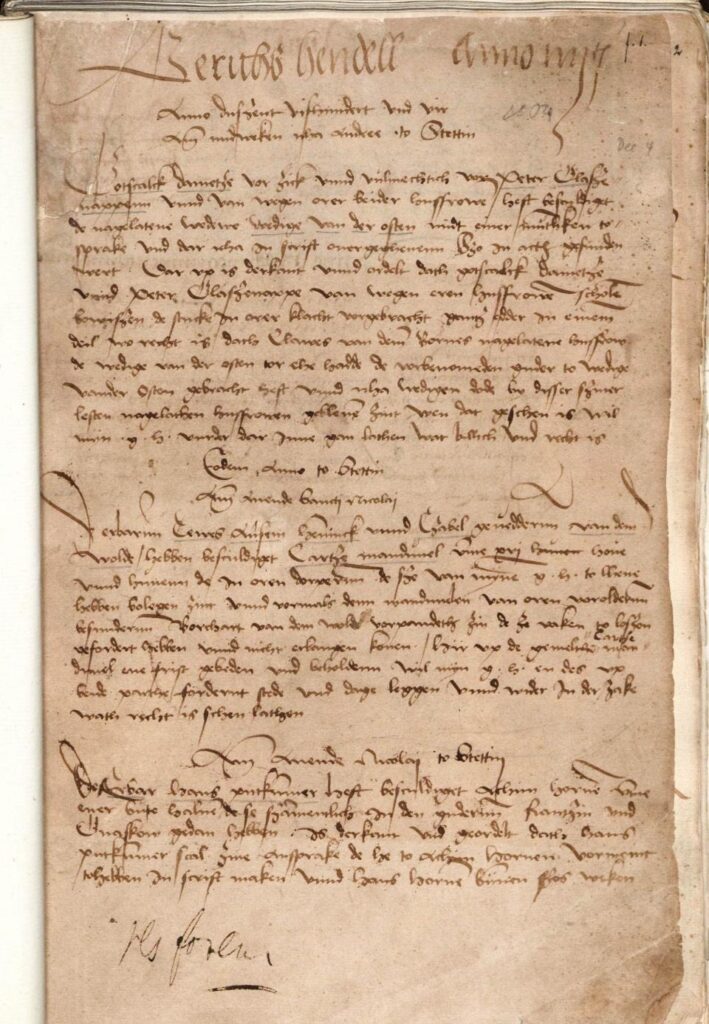
In external relations, the duchy was part of the Holy Roman Empire of the German Nation. In 1521, Duke Bogislaus was recognized by Emperor Charles V as a first-class vassal with the right to sit in the Imperial Diet in the College of Princes. On this account, the Duchy of Pomerania was obliged to bear financial burdens for the benefit of the Empire, including paying taxes for the emperors’ wars with Turkey, and in 1570, Dukes John Frederick and Barnim IX represented the emperor during the Congress of Szczecin, which aimed to end the Livonian War.
In the sixteenth and seventeenth centuries, the duchy constituted a feudal estate monarchy. The primary role was played by the nobility, who gained a dominant role in the duchy due to the process of refeudalization of rural relations (the development of the manorial-serf economy). The position of towns, with few exceptions (Szczecin, Stralsund, Anklam, Greifswald, Kołobrzeg, Stargard, Słupsk), was quite severely restricted. The peasant population was bound to the soil once again (personal, judicial, and economic serfdom) and obliged to perform corvée labor and render dues to the noble manor. The dominance of the nobility’s power over the rural population was emphatically confirmed by the peasant ordinance of 1616.
Following the death of Bogislaus X (d. 1523), power in the duchy was exercised on the principle of co-regency by his sons, George I and Barnim IX. In 1531, George I died, and in 1532, his son Philip I concluded an agreement with his uncle on the division of the state into two duchies: Szczecin and Wolgast. As a result of a drawing of lots, the former was assumed by Barnim IX, while the latter went to Philip I. Thenceforth, two separate courts and central administrations (chanceries, courts of appeal, chancellors, marshals, national rentmasters, etc.) operated in Pomerania. Concurrently, however, both rulers, as well as the Pomeranian estates, pledged to maintain a common foreign policy, uniform arrangements in internal administration, a joint estate parliament, and collective care over the university in Greifswald, the Pedagogium in Szczecin, and other foundations. The division of 1532 was dynastic in nature and was confirmed in 1541 and 1569.
In December 1534, at the parliament (diet) in Trzebiatów, Dukes Barnim IX and Philip I introduced the Reformation according to the Augsburg (Lutheran) Confession. The theological and organizational foundations of the Evangelical Church in Pomerania were drafted in 1535 by the theologian John Bugenhagen, one of the primary Lutheran reformers in Germany. The duke served as the head of the Pomeranian church, and the ecclesiastical administration consisted of three general superintendents and consistories based in Szczecin, Greifswald, and Kołobrzeg, alongside synods with provosts. At the lowest level, parishes were subordinate to the latter.
The Reformation was associated with the secularization of monasteries and ecclesiastical foundations; their wealth and landed estates were largely seized by the Pomeranian rulers and incorporated into the ducal domain. A portion of them formed the basis for new ducal foundations; among others, the Ducal Pedagogium was established from the estates of the Collegiate Chapters of St. Mary and St. Otto in Szczecin.
The Reformation altered the status of the bishopric of Kamień. Following the death of Bishop Martin Weiher in 1556, the cathedral chapter in Kamień elected the son of Duke Philip I, John Frederick, as his successor in 1557. Thenceforth, the bishopric—and primarily the secular episcopal dominion (the Kołobrzeg land), which maintained its separate legal status—became a secundogeniture of the Griffin dynasty. Other ducal sons received only appanages in the form of specific domain administrations: Barth, Bytów, and Darłowo.
The estate system of the duchy, formed during the reign of Bogislaus X and consolidated by Barnim IX and Philip I, served as the foundation of the state’s organization until the extinction of the Griffin dynasty, that is, until the death of the last Pomeranian duke, Bogislaus XIV, in 1637. This latter Pomeranian monarch, even during the course of the Thirty Years’ War, sought to reform and improve the functioning of the central authorities. Shortly after assuming governance over both duchies in 1625, he established the Privy Council in 1627, and the War Council, the Economic Council, and the office of governor (namiestnik) in 1628. In 1634, the parliament (diet) resolved to establish a Provisional Government in the event of Duke Bogislaus XIV’s death. The latter commenced its operations in March 1637 under the direction of the governor and constituted a collegial regency in the absence of a monarch. In March 1638, due to the lack of agreement between Brandenburg and Sweden regarding the inheritance of the Duchy of Pomerania after the death of Bogislaus XIV, the Provisional Government and other central offices (including the courts of appeal) dissolved, and power in the duchy was assumed by the Swedish occupying authorities.

More:
Historia Pomorza, red. Gerard Labuda, tom I, cz. 2, Poznań 1969, tom II, cz. 1, Poznań: Wydawnictwo Poznańskie 1976.
Pomorze Zachodnie poprzez wieki, red. J.M. Piskorski, Szczecin: Zamek Książąt Pomorskich 1999.
Michał Sczaniecki, Główne linie rozwoju feudalnego państwa zachodnio-pomorskiego, „Czasopismo Prawno-Historyczne” t. VII (1955), z. 1, t. VIII (1956), z. 1.