


We hold watch over the Oder
The slogan ‘We hold watch over the Oder’ returns every few or dozen years, and although the political and social contexts change, it still evokes emotions. Their scale is no longer what it was when it was conceived—during the initial postwar period—yet it remains fraught with references that trigger broad historical connotations.
The most important of these is, of course, the issue of the new Polish western border, established within the framework of the geopolitical game of the great powers at the end of World War II, which remained uncertain and controversial for a long time. This sense of temporariness accompanying the Polish settlers was further compounded by the difficulties of developing the newly acquired territories, then referred to as the Recovered Territories. Political consensus regarding the absolute requirements of the raison d’état to shape and consolidate the Polish presence necessitated propagandistic reinforcement. In this context, the deployment of a powerful, brief slogan that evoked significant wartime associations was undeniably useful. It not only countered potential German aspirations to undermine the imposed borders but also served to build a point of reference and support for the arriving settlers. In this sense, it clashed with the destruction of infrastructure and an extremely poor state of personal safety, but also with the mental encounter with a space developed by Germans over hundreds of years. For West Pomerania, the port city of Szczecin, divided by the river, was of course of particular importance here.
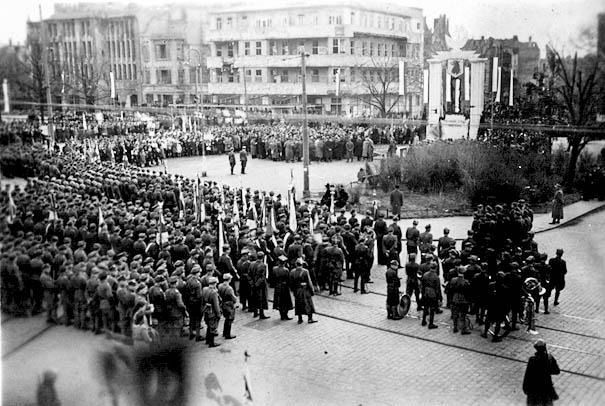
The slogan ‘We hold watch over the Oder’ became the leading motto during the celebrations of the first anniversary of the city’s capture in 1946, which were referred to at the time as the ‘Days of Szczecin.’ They gathered approximately 50,000 participants from across the country. A youth rally under the banner ‘We hold watch over the Oder’ brought thousands of young people to the city, among whom Scouts predominated. The scale of the celebrations was intended to eclipse all such gatherings organized in Poland up to that point. The city had been prepared since the beginning of April, with appeals issued for the eradication of German inscriptions and the clearing of debris. Over time, these calls became increasingly stringent. The municipal president’s decree on this matter states that property managers and the Citizens’ Militia (Milicja Obywatelska) would be held accountable for implementing the directives, and introduced penalties for non-compliance (a fine of up to 10,000 PLN, arrest for up to 6 weeks, or both penalties combined). A special committee of artists was established to oversee the embellishment of the city.
Zasadnicza część uroczystości to 13 i 14 kwietnia 1946 r. Przyjazdy uczestników rozpoczęły się jednak w piątek 12 kwietnia. Zorganizowano wtedy eliminacje do zawodów sportowych, złożono kwiaty na grobach żołnierzy radzieckich na pl. Sprzymierzonych. Tego samego dnia odbył się koncert Orkiestry Polskiego Radia. 15 kwietnia natomiast zorganizowano konferencję prasową oraz wycieczkę młodzieży z prezydentem Piotrem Zarembą oraz Ministrem Informacji i Propagandy Stefanem Matuszewskim.
The program of the celebrations opened with the statement: ‘in order to commemorate the first anniversary of the liberation of Szczecin and to manifest the Nation’s will to possess this city, the Organizing Committee of the First Celebration of "We Hold Watch over the Oder" organizes the following festivities […].’ It appears that this was the main and dominant objective, which does not preclude its exploitation for immediate political purposes, including the pre-referendum campaign or exerting pressure on the Polish People’s Party (Polskie Stronnictwo Ludowe). It is also worth emphasizing that the event was planned as a cyclical one, to be organized annually in various towns of the so-called Recovered Territories. The public was informed about the planned celebrations as early as the end of February. At the turn of April, Bolesław Bierut assumed patronage over the event.
For the local administrative authorities, the celebrations were undoubtedly an opportunity to elevate the city’s prestige and present it as a place worth settling in—one full of prospects, interesting, and at the same time, contrary to popular belief, safe.
Apart from the ministries of the Recovered Territories and Foreign Affairs, the preparations were also consulted with the Ministry of Information and Propaganda and the Main Political and Educational Directorate of the Polish Army. The program included sports competitions, concerts, film screenings, and theatrical performances.
The Accommodation Commission of the Celebration Committee provided quarters for 23,000 participants, including group accommodations for 13,000 (in hotels, boarding houses, schools, etc.) and 10,000 private lodgings with the inhabitants of Szczecin. In order to prepare the accommodations, 23 regional committees were established. Thirteen special trains arrived from across the country.
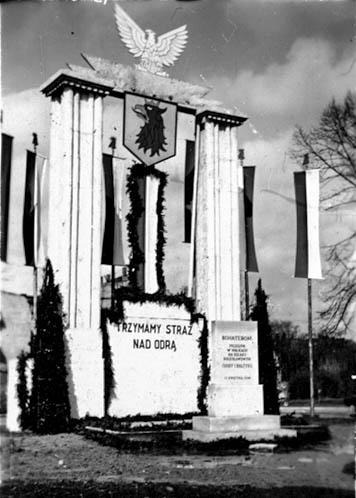
The celebrations on April 13 commenced at the then Teatralny Square (today part of it is Żołnierza Polskiego Square) with a youth pledge, speeches by the authorities, and the unveiling of a mock-up of a monument planned for the future. The design was interesting: an image of an eagle was placed atop two columns, alongside the emblem of the griffin, beneath which was the inscription ‘We hold watch over the Oder’ and a plaque reading ‘To the heroes who fell in battles along the Bolesław route of the Oder and the Baltic, April 13, 1946.’ The monument was never built; after a few weeks, the mock-up was dismantled, and in 1950, the Monument of Gratitude to the Soviet Army was unveiled on that spot.
In the evening of April 13, a parade of watercraft and a march of youth organizations were prepared at Wały Chrobrego (formerly Haken Terrasse), admired by the authorities gathered on the observation terrace. Among those present on the terrace were Bolesław Bierut, Edward Osóbka-Morawski, Marshal Michał Rola-Żymierski, Stanisław Grabski, members of the government, and the ambassadors of the USSR, England, and France. Stanisław Mikołajczyk, the leader of the Polish People’s Party (PSL), also arrived; the public perceived him as the politician closest to the tradition of the Polish Underground State and the former prime minister in London. With Mikołajczyk’s appearance, the chanting of his name began, likely initiated by members of the ‘Wici’ rural youth union and taken up by the Scouts. This was met with disapproval from the youth of the Union of Youth Struggle (ZWM), who raised cheers in honor of Bolesław Bierut. Girl Scouts from the Warsaw Banner chanted ‘accord and unity.’ Due to the significant numerical superiority of the Scouts and the ‘Wici’ youth, their chants (lasting approximately 20–30 minutes) dominated the ceremony. Appeals by the Voivode Leonard Borkowicz and Mikołajczyk himself were to no avail. Bierut was forced to step down from the rostrum. Following him, others gathered on the grandstand left as well, including Mikołajczyk, who waved his hat in farewell. The moment he entered his car, the youth attempted to lift it.
In retaliation, the following day the Scouts were barred from the military parade prepared in Wojska Polskiego Avenue, which was the culminating point of the celebrations. It commenced with a field Mass at Jasne Błonia. The correspondent of ‘Polska Zbrojna’ noted: ‘A field Mass. A military band plays "Bogurodzica" … The heads of President Bierut, Marshal Żymierski, and all those present bow low as they kneel during the Elevation on the sacred Land of the Lechites.’
This was followed by the blessing of the banners and the presentation of gifts from the city to the army. After the pioneers were decorated, a military parade took place, led by the commander of the 12th Division, General Wiktor Lemontowicz. Later that evening and from the following morning, the departure of the participants began.
The disruption of the adopted program of the celebrations, the demonstrative chants in honor of Deputy Prime Minister Stanisław Mikołajczyk, and the subsequent repressions against the Scouting movement and the Polish People’s Party (PSL) lent the event a broader, nationwide political context. Regarding the fulfillment of the objectives set for the event, it must be stated that despite the extremely challenging conditions, it was possible to organize a mass manifestation involving thousands of guests from across the country, arrange accommodation and catering for all participants, and coordinate their transport. Thus, Szczecin was successfully presented as an attractive place worth visiting. Conversely, the organizers failed to project the political unity of society or mass support for the authorities; the incident with Stanisław Mikołajczyk yielded the exact opposite effect. It also appears that the event failed to fulfill the hopes placed in it to provide propagandistic support for Polish foreign policy.
An ambiguity is also associated with the discussed events. As early as April 1946, a rumor emerged claiming that two Girl Scouts had been killed during the celebrations. Today, we can state that a railway accident occurred on April 15, 1946. It took place shortly after a transport of youth returning from the rally to Warsaw departed from Szczecin. As a result of the accident, one of the girls (Maria) was killed, while the second one (Zofia) and an unidentified boy from Toruń sustained injuries.
More:
Radosław Ptaszyński, Trzymamy straż nad Odrą. Propaganda – Fakty – Dokumenty, Szczecin: Instytut Pamięci Narodowej 2007
Radosław Ptaszyński