


Bogusław XIV ostatni Gryfita
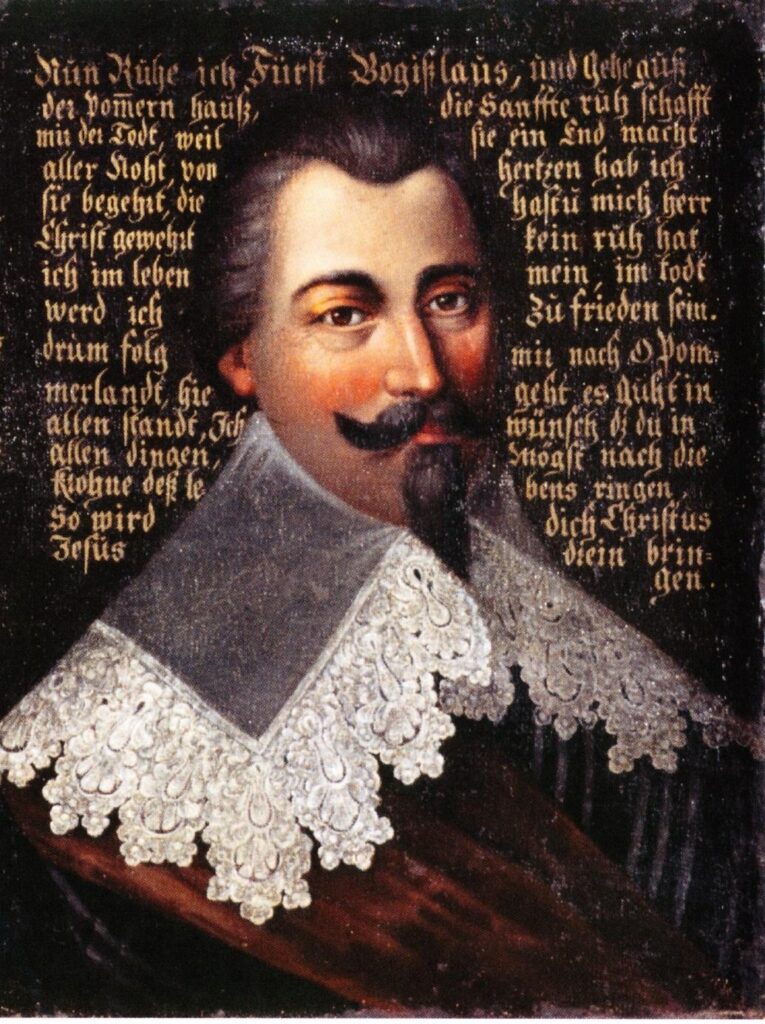
Ostatni Gryfita Bogusław XIV urodził się 31 marca 1580 roku na zamku w Barth i był trzecim z kolei synem Bogusława XIII i jego pierwszej żony Klary księżnej brunszwickiej. W młodości wraz z braćmi pobierał nauki domowe. Jednocześnie był też przygotowywany przez ojca do pełnienia samodzielnych rządów. Uczestniczył w obradach sejmików stanów pomorskich, zapoznawał się z ustrojem prawnym i historią Pomorza. W 1593 roku po raz pierwszy wyjechał za granicę do Meklemburgii podążając wraz z bratem Filipem na ślub i wesele swojej siostry Klary Marii.
The completion of the young duke’s education was the so-called grand tour, during which he was to become acquainted with distant countries and acquire worldly refinement. Bogislaw XIV set out on his European journey in 1605. He began by traveling by ship along the German coasts and visiting the Hanseatic port cities located there. He then reached the Netherlands, where he familiarized himself with the modern economy of that country and visited the most important cities of Holland, taking an interest in art and architecture, especially military architecture. From the Netherlands, he went to England, with London leaving a strong impression on him. While in England, he also ventured to Scotland to admire the rugged mountain landscapes. The next country on Bogislaw XIV’s grand tour was France, where he naturally visited Paris. From Paris, he traveled south and, crossing the Alps, arrived in northern Italy. From there, passing through southern Germany, he returned to Szczecin after the death of his father.
The death of Bogislaw XIII in March 1606 changed the situation in the duchy. The throne in Szczecin was taken by Duke Philip II. Under these new circumstances, Bogislaw XIV, together with his younger brother George II, received possession of the Darłowo domain, the largest in the Duchy of Szczecin. Its revenues became the basis for the upkeep of both dukes. Their residence from then on was the castle in Darłowo. When the duke, residing in Darłowo, passed the age of thirty, the family council decided that he should marry. As a consequence of this decision, after lengthy negotiations, a marriage contract was signed in October 1614 in Sonderborg by Philip II, Duke of Szczecin, and John the Younger, Duke of Schleswig-Holstein. The result of the agreement was the wedding, celebrated on February 19, 1615, between Bogislaw XIV and Elisabeth, Princess of Schleswig-Holstein. The modest wedding celebrations were held at the castle in Darłowo. After the wedding, the castle in Darłowo became the exclusive residence of the young couple. In 1615, Duke George II moved to his residence in Bukowo, a former Cistercian monastery that had been converted into a ducal seat.
From his peaceful and rather monotonous life in Darłowo, Bogislaw XIV was jolted in 1620 by the unexpected death of Duke Francis I. Under these new circumstances, he had to assume rule over Szczecin. Bogislaw XIV found himself reigning in extremely difficult times. In the Empire, more and more states were being drawn into the Thirty Years’ War. After the suppression of the Bohemian uprising, imperial troops shifted their operations to the Palatinate and neighboring Rhineland principalities. It became necessary to strengthen Pomerania militarily, a task to which Francis I had devoted much effort during his two years of rule in Szczecin. His plans included the creation of a several-thousand-strong Pomeranian army and the construction of modern fortifications around Szczecin. These plans, however, were never realized, and Bogislaw XIV inherited from his late brother a debt of 150,000 florins, which he pledged to repay. The lack of significant financial resources of his own and the reluctance of the Pomeranian estates to allocate money for military recruitment meant that Pomerania was left completely defenseless. This forced Bogislaw XIV to pursue a policy of neutrality toward both sides of the conflict in Germany, that is, toward Catholics and Protestants alike.
The situation of the dynasty became catastrophic in 1622, after the death of the young Duke Ulrich, who was the only Griffin who might still have produced a male heir. The long-standing marriages of Duke Bogislaw XIV of Szczecin and Philip Julius of Wolgast had remained childless for years. After Ulrich’s death, the titular bishop of Kamień, both the Danish and Polish sides began maneuvering to install their own candidates in the now-vacant bishopric. In this situation, in 1623, Bogislaw XIV was forced to assume the episcopal office himself, which entailed administering the Prince-Bishopric.
In 1625, after the unexpected death of Duke Philip Julius of Wolgast, Bogislaw XIV became the only surviving male member of the Griffin dynasty. In 1626, he officially assumed power in the Duchy of Wolgast, receiving the feudal homage of the Wolgast estates. The reunited Pomerania, however, found itself in an extremely difficult situation. In the Empire, King Christian IV of Denmark had intervened on the Protestant side in 1625, but after a series of defeats suffered by his army in the autumn of 1626, the fighting shifted to the northern parts of the Empire. Catholic troops under Wallenstein occupied Brandenburg and Mecklenburg, increasingly threatening to invade Pomerania. At the same time, in 1626, the Polish-Swedish conflict flared up along the eastern borders of the duchy. Fighting took place in Royal Prussia, but both sides sent raiding parties into Pomeranian territory in search of provisions and fodder. At first, the villages near the border suffered, but over time the raids—especially the Swedish ones—penetrated deeper, even as far as Słupsk. In this situation, Bogislaw XIV was forced to raise a small Pomeranian force (about 150 infantry and 100 cavalry) to guard Pomerania’s border with the Polish-Lithuanian Commonwealth. These mercenary troops were supported by the levy of the Duchy of Szczecin. In April 1627, Pomerania’s neutrality was violated when units recruited by the Swedes for the war in Prussia marched through the duchy without Bogislaw XIV’s consent. This somewhat sobered the Pomeranian estates, which decided to raise an army of 1,500 men. These actions, however, came far too late.
From 1620 onward, Bogislaw XIV undertook diplomatic efforts in Vienna to have Ferdinand II recognize Pomerania’s neutrality, which the emperor ultimately declared. However, in the autumn of 1627, faced with the growing Swedish threat, Ferdinand II decided to have the Imperial army occupy Pomerania. When Pomeranian informants at the imperial court in Vienna reported this decision to Bogislaw XIV, he tried, while traveling through Pomerania, to avoid at all costs being handed the imperial patent. Nevertheless, Wallenstein’s envoy, Count Arnim, managed to surprise Bogislaw XIV in Franzburg in November 1627. There, brief negotiations took place (the Franzburg Capitulation), as a result of which the duke, as an imperial vassal, agreed to allow the Imperial army to enter Pomerania. Thus began a harsh occupation that devastated the Pomeranian population (numerous requisitions, levies, and atrocities). Bogislaw XIV did what he could to alleviate the suffering of his subjects, but his efforts in Vienna achieved little. Deprived of real power, he had less and less influence over what was happening in his state.
Not all towns admitted Imperial soldiers into their quarters. Stralsund, with its modern earth fortifications, put up resistance. In January 1628, the siege of Stralsund began despite Bogislaw XIV’s vigorous diplomatic efforts. At first, the city received support from Denmark, and later from Sweden, which concluded a formal defensive alliance with the city council. Swedish supplies and weapons flowed into Stralsund’s port, and Swedish soldiers fought alongside the town militias on the ramparts. The city’s effective defense forced the lifting of the siege in July 1628. Negotiations followed, with Bogislaw XIV taking part, concerning the neutralization of the city. They ended in failure, and a Swedish garrison remained in Stralsund. Meanwhile, the military situation in the Empire shifted. Defeated Denmark withdrew from the conflict (Peace of Lübeck, May 1629), and after the end of the Polish-Swedish war (Truce of Altmark, September 1629), Gustavus Adolphus was preparing to intervene in the Empire on the Protestant side.
Perceiving a clear threat from the Swedish side, Bogusław XIV took diplomatic steps to prevent the Swedes from occupying Pomerania, to ensure they left Stralsund, and to make them respect Pomerania’s neutrality. However, the Pomeranian embassy returned from Stockholm empty-handed. In June 1630, the Swedish army landed on Rügen, screened by an reinforced garrison from Stralsund. Exploiting the surprise of the Imperial troops dispersed across Pomerania, Gustavus Adolphus appeared with a part of his army near Szczecin as early as July. The old, somewhat ruined castle of Barnim IX in Oderberg became the Swedish king’s headquarters. Threatening to bombard Szczecin, Gustavus Adolphus forced Bogusław XIV into negotiations, which were undertaken in Oderberg. They concluded with a Swedish-Pomeranian alliance. At that moment, the Duke of Pomerania was declared a traitor by the Emperor.
It should be emphasized that Bogislaw XIV became an ally of the King of Sweden not by his own choice, but under compulsion. The latter, in his diplomatic maneuvers, did not take Pomerania’s interests into account at all. For example, he declared to the Elector of Brandenburg that, in exchange for joining the Swedish camp, the Elector would receive all of Pomerania after Bogislaw XIV’s death. On another occasion, he suggested that Sweden, for liberating Pomerania from Imperial occupation, should receive a portion of its territory.
Only after the death of Gustavus Adolphus at the Battle of Lützen (November 1632) did Bogislaw XIV regain a measure of independence and begin his own political maneuvering, attempting to secure the Pomeranian throne for the last Griffin in the female line, Ernst Bogislaw von Croy. The latter, together with his mother, Duchess Anna—sister of Bogislaw XIV—had been residing in Pomerania since 1622. The first step in this plan was the granting of the bishopric of Kamień, along with the lands of the Prince-Bishopric, to Ernst Bogislaw in June 1633. This decision was not well received in Sweden. The Elector of Brandenburg also strongly objected, as he was counting on inheriting the whole of Pomerania upon the imminent death of Bogislaw XIV, basing his claim on succession treaties concluded between the Hohenzollerns and the Griffins. Nonetheless, Bogislaw XIV persisted in his efforts to place von Croy on the Pomeranian throne. He attempted to persuade King Władysław IV of Poland to grant Ernst Bogislaw the Lębork-Bytów fief and to recognize von Croy as a vassal of the Polish-Lithuanian Commonwealth. This initiative, however, ended in complete failure.
What is worse, in April 1633 the duke suffered a stroke. Partially paralyzed and speaking with difficulty, he had to be carried in a litter. He also finally lost any influence over what was happening in the duchy. Pomerania was now completely dominated by the Swedes, under whose supervision a Regency Council was established in Szczecin in 1634. It took over most of the duke’s prerogatives. When, in 1635, an Imperial offensive threatened Szczecin, the ailing ruler was taken to Koszalin. He returned to Szczecin the following year, devoting the last months of his life to religious contemplation. The last Griffin, Bogislaw XIV, died at Szczecin Castle on March 10, 1637, and was laid to rest in the castle crypt. His solemn, princely funeral, however, was not held until 1654.
More:
Zygmunt Boras, Bogusław XIV – ostatni Gryfita, „Przegląd Zachodniopomorski” 1967, z. 2.
Zygmunt Boras, Książęta Pomorza Zachodniego, Poznań: Wydawnictwo Naukowe UAM 1996.
Edward Rymar, Rodowód książąt pomorskich, Szczecin: Książnica Pomorska 2005.
Radosław Gaziński