


The beginnings of railways in Western Pomerania (until 1918)
Western Pomerania on the Threshold of the Industrial Revolution
Before railway routes diversified the landscape of Western Pomerania (the Province of Pomerania), traveling across it frequently resembled a struggle with the elements. In the first half of the 19th century, Pomerania was an agricultural region where the rhythm of life was dictated by the seasons rather than the timetables of mail coaches. The transport of goods, agricultural produce, and timber from the interior to the Baltic ports in Stralsund, Greifswald, Świnoujście, Kołobrzeg, Darłowo (Darłówko), Ustka, and Łeba relied on a road network of varied and often very poor quality. Macadamized routes were far from standards that would allow for fast and mass transport. The economy, based on landed estates and slowly developing manufactories, was suffocating from a lack of efficient communication arteries. It was against this background that the steam revolution, which did not bypass the Prussian state, appeared as an opportunity for a complete civilizational transformation. The railway was meant not only to bring distant provinces closer together, but above all to integrate the Pomeranian market with dynamically developing Berlin and open it up to the world (at least in the original assumption) via the port of Szczecin.
The golden era of Pomeranian railways began with a vision that was initially treated by many with a healthy dose of skepticism. The primary driving force was the ambition to connect the maritime window to the world—Szczecin—with the developing capital of Prussia, Berlin. The first such distinct impetus came from the community of Szczecin merchants, practical people gifted with broad horizons. On March 24, 1835, editor Adolf Altvater published a groundbreaking memorandum to the merchant authorities in Szczecin in the columns of the “Börsennachrichten der Ostsee” newspaper. In it, he argued that the construction of a modern railway connection was an absolute necessity of the era.
This document became an important contribution that led to the rapid establishment of the Berlin-Szczecin Railway Committee (Berlin-Stettiner Eisenbahn-Komitee). It was headed by the energetic Lord Mayor of Szczecin, Masche, who fully understood the needs of the developing city. The technical side of the venture was the responsibility of Royal Chief Inspector Neuhaus—an engineer whose knowledge was soon to transform bold plans into reality.
The venture faced financial challenges from the very beginning. Initial estimates, prepared with great optimism, amounted to 2.2 million thalers. However, it quickly turned out that complicated terrain conditions and the need to construct numerous engineering structures would significantly increase this amount. The final costs closed at a sum of nearly 2.75 million thalers, which was a huge amount at the time. Despite the Prussian government’s initial distance toward the investment near the end of the reign of Frederick William III, his successor, King Frederick William IV, proved to be a ruler much more open to technological innovations. Unlike his conservative father, the new monarch officially issued a concession for the construction of the line in October 1840 and sanctioned the statutes of the joint-stock company, guaranteeing it the necessary political and, consequently, financial support.
Construction and Opening of the Berlin-Szczecin Line (1840-1843)
Construction work was carried out with immense dedication. The designated route, 135 kilometers long, led through such towns as Bernau, Eberswalde, and Angermünde. An extraordinary engineering achievement over this relatively short (from today’s perspective) distance was the construction of several dozen railway bridges and culverts. They tackled river valleys, wetlands, and uneven terrain, which required an enormous expenditure of manual labor and the application of modern technical solutions of the time. August 15, 1843, when the entire line from Berlin to Szczecin was ceremoniously opened, permanently went down in the history of the Province of Pomerania. The rank of this event was evidenced by the personal presence of the monarch himself, Frederick William IV. The railway immediately aroused widespread fascination. As records from contemporary residents of Bernau show, crowds of onlookers waited at stations for hours to see the smoking machines. Free trial train rides were organized, which, due to huge interest and the lack of a possibility for immediate return, forced enthusiastic passengers into a multi-kilometer march back home on foot. Although the timetable initially provided for only a few runs a day, and night traffic practically did not exist due to safety concerns, the technological novelty very quickly became the main driver of the economy of the towns lying along the route.
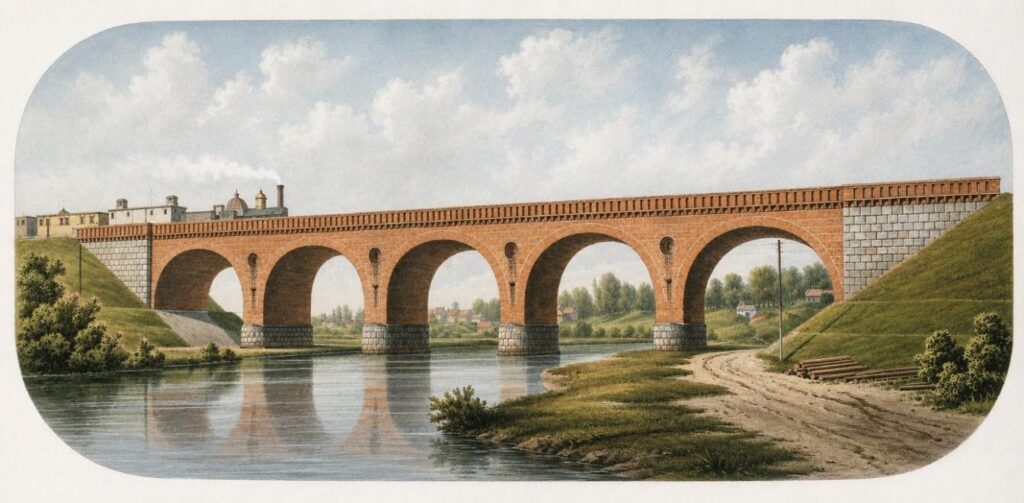
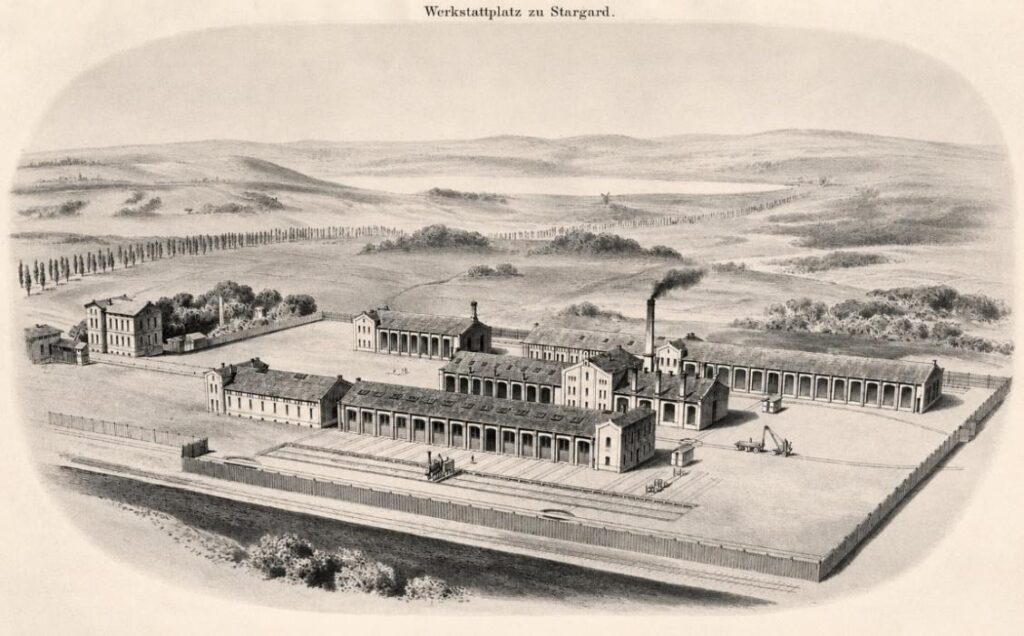
The great commercial success of the Szczecin line triggered an avalanche of further investments. The Berlin-Szczecin Railway Company, possessing growing capital, began the gradual and systematic extension of its railway lines. The main goal became to connect the agricultural hinterland of Further Pomerania (Hinterpommern) with markets and Baltic ports. As early as May 1, 1846, Szczecin gained a railway connection with Stargard, and in subsequent years, technically difficult but profitable expansion to the east and north continued. The schedule for putting subsequent major sections into service is presented in the list below:
Expansion of the Pomeranian railway network
| Railway line section | Date of opening of the line |
| Szczecin – Stargard | May 1, 1846 |
| Białogard – Koszalin | June 1, 1859 |
| Koszalin – Słupsk | July 1, 1869 |
| Szczecin – Świnoujście | May 15, 1876 |
The extension of tracks to the main administrative and economic centers brought an unprecedented boom in trade. In the eastern part of the Province of Pomerania, laying the main railway arteries became a stimulus for profound social transformations. The development of rail transport significantly accelerated land improvement processes and agricultural reforms, including, for example, the activity of land improvement cooperatives. Local authorities (especially district administrators) quickly recognized the potential of the railway as a tool for exporting huge quantities of timber and agricultural produce. Spatial planning in the Province of Pomerania gained a completely new dimension, and the traditional, isolated character of East Pomeranian towns began to fade into oblivion.
Białogard (Belgard) – Koszalin (Cöslin) section. Topographical map of the Further Pomeranian Railway route with mileage in Prussian miles. Second half of the 19th century. Deutschlands Städtebau: Stettin, hrsg. von Magistrat, Berlin-Halensee 1925 (insert).
With each passing decade, the significance of rail transport increased, which did not escape the attention of the central Prussian authorities, and from 1871 onwards, following the unification of Germany, the pan-German ones. The Iron Chancellor, Otto von Bismarck, fully understood that an efficient, unified network of tracks was not only the nerve of a powerful state economy, but also of fundamental importance for smooth military logistics. A system in which independent, private joint-stock companies with diverse tariffs and regulations operated within a single state was becoming, in the long run, not only inconvenient but also inefficient.
As a result of Bismarck’s long-term policy, following a phase of intensive negotiations and legal-economic pressure, the assets of the Berlin-Szczecin Railway Company were completely nationalized in 1880. These assets, which included hundreds of kilometers of routes and a large rolling stock fleet, among other things, came under the direct management of the state administration—more specifically, the newly established Royal Railway Directorate in Szczecin (Königliche Eisenbahndirektion Stettin – KED Stettin).
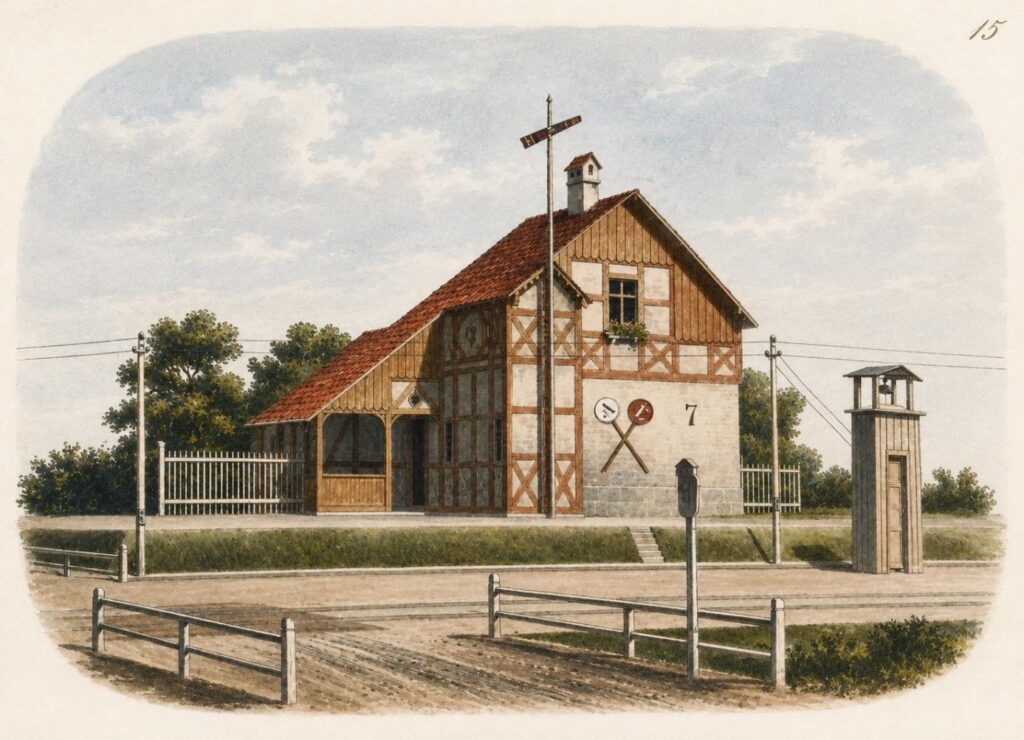
The incorporation of the Pomeranian railways into the framework of the Prussian state system forced the introduction of uniform signaling regulations, the unification of workers’ rights, and the standardization of timetables. This process was completed by the end of the century. As a result of the major reform of transport organization, initiated in 1895 by the Minister of Public Works, Carl von Thielen, the Szczecin directorate strengthened its position, managing 2,205 kilometers of tracks at that time. It thus constituted one of the largest hubs in the entire Prussian system, overseeing vast territories from the Oder all the way to Kołobrzeg (the remaining part of the Province of Pomerania was under the jurisdiction of the directorate in Gdańsk at that time).
Following the expanding network, there arose a necessity to construct passenger service facilities and a massive technical depot. The first Szczecin station from 1843, originally built as a terminal station (with dead-end tracks), ceased to fulfill its functions as early as the 1860s due to drastically increasing traffic volume. It was decided to completely rebuild it in 1869 into a modern through station, which was an extremely complicated operation in the congested and spatially limited riverfront area of the city.
Great bridge structures henceforth became a permanent element of the landscape of the new era. Steel crossings became examples of engineering architecture, including the great viaduct and bridge over the Finow Canal near Eberswalde, as well as powerful engineering structures erected as rivers flowing into the Baltic Sea were conquered. In the wake of the stations, huge engine sheds, turntables, and repair workshops (Reichsbahnausbesserungswerk – RAW) were established, employing thousands of qualified workers. The development of engineering became a symbol of a permanent civilizational change.
Darłowo (Rügenwalde). A two-story brick railway station building covered in Virginia creeper, with visible staff and a platform clock. Turn of the 20th century. Postcard from the author’s collection.
The main state trunk lines, though efficient, could not reach every corner of agricultural Western Pomerania. To prevent the exclusion of smaller settlements, starting from the 1890s and based on the Prussian Law on Local Railways and Private Sidings (Preußisches Kleinbahngesetz of 1892), a spontaneous boom in narrow-gauge railway networks (Kleinbahnen) began. They constituted a kind of bloodstream feeding the main arteries, built most often from county (municipal) funds and by private investors associated in local companies.
Precisely thanks to such initiatives, entire districts were integrated into the railway network. District railways enabled not only the efficient transport of valuable agricultural produce and large masses of timber from Pomeranian forests to transfer stations, but also contributed to the increased mobility of people from small towns and villages. Narrow-gauge railways had their own unique charm: small locomotives pulled mixed passenger and freight trains with just a few small carriages at a leisurely pace, traversing orchards, fields, and the backyard gardens of small village residents. At its peak, the KED in Szczecin supervised, in the form of technical oversight, a network of over 40 independent local and narrow-gauge administrations, forming a colorful mosaic on the transportation map of the Province of Pomerania.
Handling the growing volume of traffic required hundreds of locomotives. Although in the early years of operation these machines were brought from various, often very distant plants and even imported from abroad, over time production took on a decidedly domestic, intra-Prussian character. August Borsig’s plants in Berlin played a major role, supplying equipment for the Berlin-Szczecin line almost from the very beginning of its operation. In Pomerania, however, a powerful, independent player in the machinery industry emerged. The great “Vulcan” machine factory began operations in Drzetowo near Szczecin; although primarily famous for shipbuilding, it also grew into a giant in the field of railway rolling stock construction. The first two historic locomotives produced in 1859 by “Vulcan” on commission from a local company were named “Bellona” and “Hebe”.
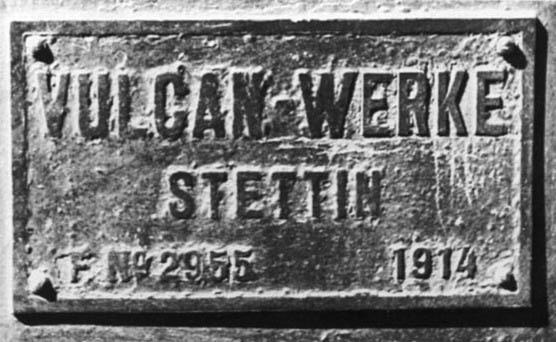
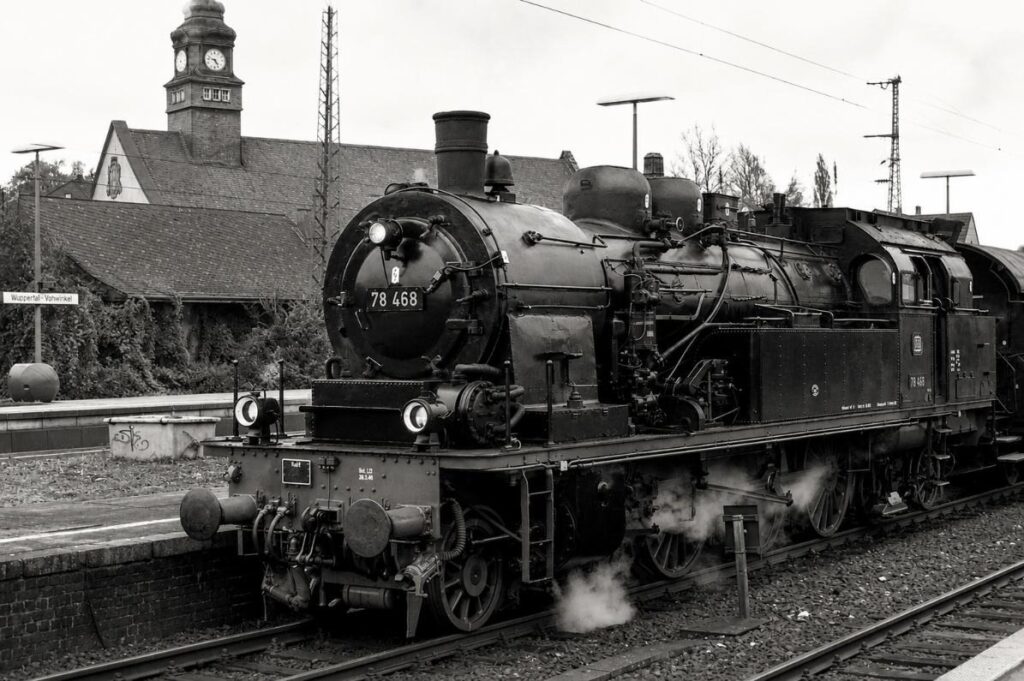
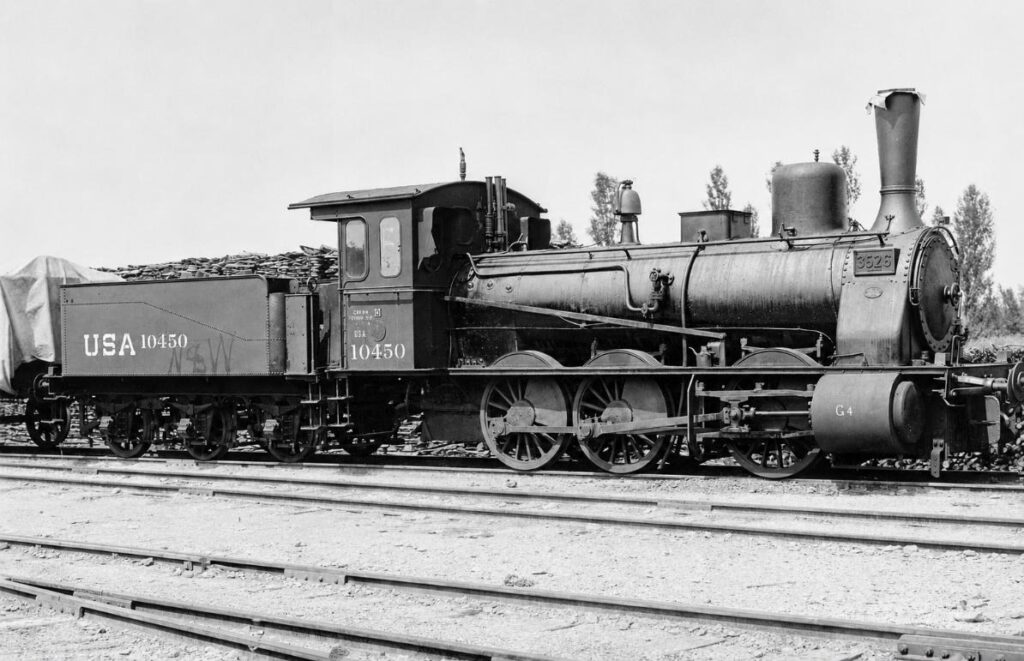
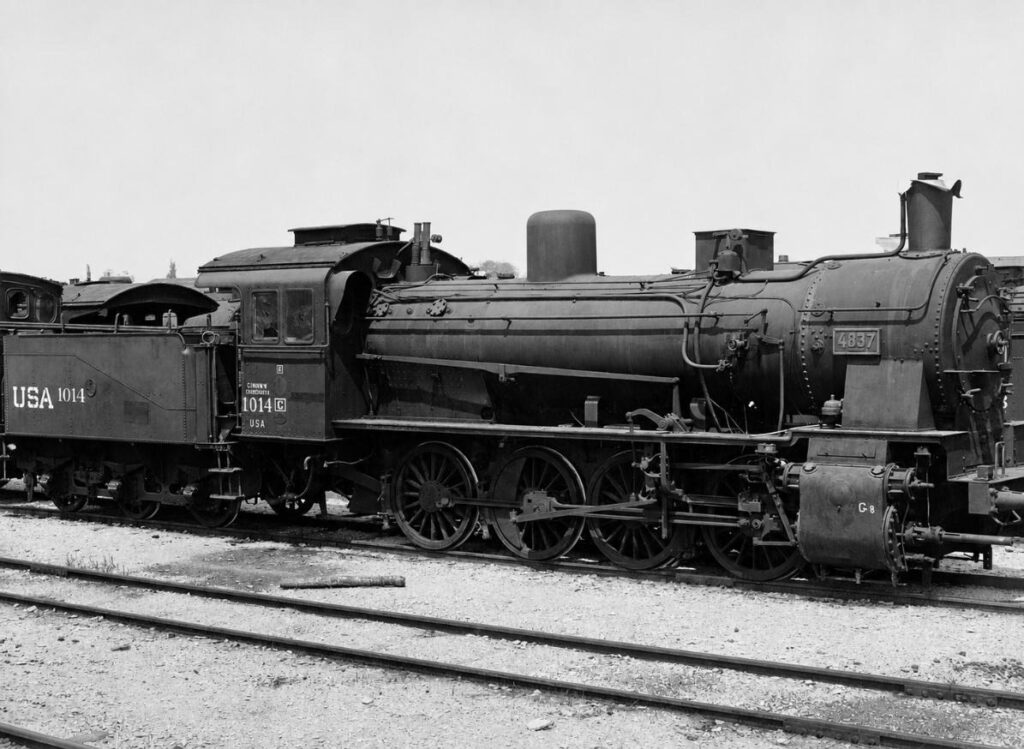
Over the next few decades, these plants produced thousands of steam locomotives. It was a time of enormous variety among the built machines: from light tank locomotives serving on sidings, through express locomotives (Schnellzuglokomotiven), to heavy designs intended for the transport of raw materials (Güterzuglokomotiven), such as the Prussian T18 series valued by crews or the massive G 4.2 and G 8. Smoke rising from their chimneys over the tracks became a daily element of the Pomeranian landscape, and the profession of a locomotive driver was surrounded by universal respect and prestige.
Maritime crossings and the famous Royal Line
The history of the Szczecin railway directorate is not only the history of railways on land, but also solutions unique on a Prussian scale that connected railway tracks with the Baltic Sea. The north-western edges of the province, cut through by lagoons and straits, made it necessary to guarantee the continuity of travel. The introduction of ferry services thus became a logical step in expanding the transport offer. Railway ferries to islands, such as Świnoujście–Ostrów (Ostswine), regularly transported passengers and freight wagons, eliminating terrain barriers.
However, the greatest resonance was caused by the creation of a major international transport route to Sweden. From May 1897, small mail steamers operated on the route between the Pomeranian port of Sassnitz on Rügen and the Swedish Trelleborg, which required cumbersome transfers. A true revolution took place on July 6 and 7, 1909, when, with the participation of the crowned heads of both states, a connection was solemnly opened using powerful train ferries, onto the decks of which entire train compositions rolled directly. This route, named the Royal Line (“Königslinie”), set completely new standards of travel in Northern Europe. Luxurious sleeping cars could run unhindered on the route from Berlin directly to Stockholm or Oslo. As an interesting historical tidbit, it is worth mentioning that it was precisely via this route, in April 1917, that the Bolshevik leader, Vladimir Lenin, was transported by a special train as he headed to revolutionary Petrograd—an event that, as it later turned out, influenced the fate of the world.
The harmonious and planned development of the Prussian and German transport system was halted on August 1, 1914, with the announcement of general mobilization. For the Szczecin railway directorate, this date marked a sudden transition from a civilian mode, dominated by tourist and economic traffic, to a fully wartime one. The first days of August at Pomeranian stations were marked by unimaginable chaos. Confused holidaymakers, who had been resting in Baltic resorts, crowded the trains in a panic to flee home. Their paths crossed with endless, priority military transports rushing with operational units to the east, toward the Russian front.
From the very first moments, the militarized administration had to meet the unprecedented demands of military logistics. Railway junctions were transformed into transfer points, supply hubs, and first-aid medical stations. Charitable organizations and station missions contributed to these efforts, providing support to the exhausted and wounded in cooperation with the Red Cross. Suffice it to say that during the fierce fighting in East Prussia in early September 1914, at an improvised supply point organized at the freight station in Szczecin, on a single day (September 2) alone, they managed to feed and supply a staggering number of 17,000 drafted recruits and fighting soldiers.
The protracted conflict brought catastrophic consequences for the technical base. Half of the trained, pre-war personnel of men in their prime were mobilized into the army or front-line railway battalions. This caused a phenomenon on an unprecedented scale: the mass employment of women. Women took upon their shoulders the burden of work as dispatchers, telegraph operators, station mistresses, and not infrequently also performed physically demanding tasks in servicing steam locomotives and clearing tracks of ice and snow, striving to maintain the functioning of the ruined infrastructure.

The war years meant rapid devastation of the entire transport system in Pomerania. The shortages of high-grade coal from Silesian mines deepening with each month, as well as severe shortages of lubricants, forced the Szczecin railway directorate to make drastic cuts in timetables. Tracks on secondary inland lines, deprived of ongoing maintenance, quickly suffered technical degradation. Some local routes were suspended entirely, limiting operations only to the minimal freight traffic necessary for transporting timber or basic food to save the starving urban population. When on the cold November days of 1918 the dust of the First World War fronts settled, the railway system of Western Pomerania was on the verge of complete organizational exhaustion and technical ruin, requiring reconstruction often from the ground up in the upcoming Weimar era.
More:
Kolej na Pomorzu Zachodnim 1843-2013, red. Jerzy Baranowski, Szczecin: Wydawnictwo INES 2013.
Vorpommerns Eisenbahnen in historischen Ansichten, red. Heiko Bergmann, Ueckermünde: Küsten-Regionalverlag 2001.
Kacper Pencarski