


Capital Stargard
After the end of the Thirty Years’ War, Stargard had endured the first of two great cataclysms that marked its history. The events that unfolded over those several years halted the city’s development for more than half a century. The first blow was an epidemic that took a deadly toll among the townspeople between 1623 and 1625, claiming 3,381 lives. Then, in 1628–1629, the commander of the Imperial army garrison imposed a heavy contribution on the city, significantly depleting its treasury.
Another lasting scar in the memory of Stargard’s residents was left by the events of October 7, 1635. A great fire consumed almost the entire city as a result of a reckless order issued by the Swedish garrison commander. Only St. John the Baptist Church and eighteen surrounding houses remained untouched. Overall human losses in Stargard amounted to about 50% of the prewar population. Those who survived fled to Szczecin and neighboring towns, leaving around three hundred houses abandoned within the city. The demographic and material situation did not improve even after the end of the Thirty Years’ War. By 1653, only 2,500 people lived in Stargard, compared to nearly 7,000 before the outbreak of the conflict.
Between 1641 and 1655, only 114 new citizens were granted municipal rights, and by 1668, another 150 had been admitted. In 1664–1665, uninhabited houses, huts, and cellars accounted for about 42.4% of all buildings. As a result, out of 365 brick houses that existed in 1627, only 209 were still standing by 1665.
ChatGPT powiedział: In the second half of the 17th century, the part of the former Duchy of Pomerania that included Stargard fell under the rule of the Brandenburg Elector, while the western portion of the duchy, including Szczecin, remained in Swedish hands. Elector Frederick William, determined to bring the Pomeranian estates under his control, convened a regional parliament (Landtag) in Stargard on July 19, 1653. The resolution adopted by this assembly on July 11, 1654, defined the political system and organization of Brandenburg Pomerania. The administration of Pomerania was subordinated to the Privy Council in Berlin. It functioned as a collegial body consisting of a president, a chancellor, the directors of the Court of Appeals and the Economic Chamber, as well as two councillors. Additionally, several autonomous authorities operated under Berlin’s control — the Court of Appeals, the Consistory, the Economic Chamber, and the War Commissariat. The first Governor (and later President) at the head of the Pomeranian Administration was Prince Ernest Bogusław von Croy, who held this office until 1678.
Initially, the capital of Brandenburg Pomerania was Kołobrzeg. However, in 1668, the seat of the Pomeranian Administration was moved to Stargard, which — with interruptions in 1674–1677 and 1683–1685/1686 — served as the capital city until 1723. Prince Ernest Bogusław von Croy chose as his residence the former home of the deceased Swedish general war commissioner Caspar Kempendorff, located on a property along what was then Pyrzycka Street. According to the Elector’s report, in November 1668, the estate, including a stable for twelve horses, was in good condition. Nevertheless, Prince von Croy ordered a reconstruction of the residence, which was still ongoing in May of the following year. For this reason, with the permission of Frederick William, the prince temporarily carried out his administrative duties from Słupsk.
The transfer of the government administration to Stargard led to the establishment of a Reformed (Calvinist) congregation. The first service, held on March 14, 1669, provoked strong public outrage due to the hostility of the Lutheran townspeople toward the Calvinists. The sermon, written by Pastor Franz Siefert, was later published in print, prompting an anonymous author to issue a rebuttal. By order of Elector Frederick William, the polemical pamphlet was publicly burned in the marketplace on February 21, 1670, in front of onlookers. Most members of the Reformed congregation were state officials, who in 1673 petitioned to use part of the former Augustinian church. The proposal met with fierce opposition from both the City Council and the general public. The Elector then planned to build an entirely new church for the Calvinist community, but the war with Sweden (1674–1679) thwarted these intentions. Eventually, on January 14, 1682, the congregation was granted shared use of the former St. Augustine’s Church with the Lutherans — under the penalty of a thousand thalers imposed on anyone who resisted this decision. This decree further inflamed religious tensions in the city, culminating in Calvinists being pelted with stones by Lutheran worshippers. The incident drew attention in Berlin, prompting the Elector to dispatch two squadrons of dragoons to the town on the Ina River, while two Lutheran pastors were accused of instigating unrest. As a result, the former Augustinian church became the burial site for members of the governmental elite and for the French colony that had formed around 1687 — composed of Huguenot religious refugees of the same faith.
At the time Stargard assumed its capital function, it was the second-largest city in Brandenburg Pomerania, with a population of only 2,550 inhabitants. After the transfer of the provincial offices to Stargard, the number of citizens granted municipal rights increased only during the next five years (1669–1674). However, the vast majority of these newcomers were non-locals. Between 1641 and 1674, out of 383 new citizens, only four were children of native Stargard residents. By 1684, the number of houses in the city had risen to 388.
On December 26, 1677, after a six-month siege, the Swedish-held city of Szczecin capitulated to the Elector. Frederick William immediately received the oath of allegiance from the citizens of Szczecin, and Georg Caspar von Flemming, the director of the Stargard Court of Appeal, was appointed to head the Brandenburg administration governing the Swedish part of Pomerania. However, just two years later, under the terms of the Treaty of Saint-Germain-en-Laye, the Elector was forced to return all the occupied territories, including Szczecin, to Sweden, except for a narrow strip of land along the Oder River and the Szczecin Lagoon.
Including Szczecin’s surrounding areas — Gryfino, Goleniów, and Kamień Pomorski. On the Swedish side, only Dąbie remained, regarded as part of the Szczecin fortress. Consequently, Stargard continued to play the most important role in the Brandenburg administration of Pomerania.
In 1668, the Elector established in Stargard the College for Trade Affairs. A Commission for the Regulation of Municipal Matters was also created to define the main directions
of urban economic development. The main task of the College for Trade Affairs was to revitalize trade between Stargard on the Ina River and Kołobrzeg. In this way, the Elector sought to make the new capital economically independent from Swedish-held Szczecin. However, these efforts did not yield the desired results. Despite higher licensing fees, it remained more profitable to maintain existing trade relations with Szczecin. Each year, a few small vessels entered the port at Inoujście, taking on goods floated down from Stargard and Goleniów. According to estimates, the ships’ holds were filled with hundreds of lasts of grain and timber. In 1680–1681, the Elector even considered building a canal between Kostrzyn and Stargard, which was intended to expand the grain market’s reach — but the project was never realized due to technical difficulties.
An important measure supporting economic development was the establishment of the Brandenburg mint in Stargard, whose purpose was to produce coins with a higher silver content. It was believed that better-quality currency would drive out the inferior Polish coins, which were widely used in Brandenburg Pomerania. The mint master and lessee was Siegmund Dannies. Despite issuing, between 1689 and 1694, circulating coins with denominations of 1/12, 1/3, and 2/3 thaler, as well as pfennigs, 2-, 3-, 4-, and 6-pfennig coins, and 1/48 thaler pieces, with a total circulation value of 973,466 thalers, the use of Brandenburg currency did not increase significantly.
Nevertheless, Stargard’s merchants successfully regained control of the Pomeranian and Neumark markets that had previously been dominated by Szczecin. This became especially evident after 1679, when the Elector himself sought to boost trade and production in Stargard. A significant role was played by the French colony established in 1687, which became the earliest and largest Huguenot settlement in Brandenburg Pomerania. Thanks to their presence, textile workshop production increased, along with related trades such as dyers and tailors. The tailors’ guild gained particular notoriety in 1673, when a young master tailor, acting in self-defense during a brawl, stabbed another craftsman to death. Although he confessed and the court recognized that he had acted in self-defense, after more than a year in prison, he was nevertheless executed by sword in the town square.
Other crafts also flourished, especially those related to the construction industry. There was a notable increase in workshops working with wood — from 14 in 1665 to 41 in 1680. The carpenters’ guild, numbering 15 masters, held the leading position, driven primarily by the reconstruction of the city and region devastated by the Thirty Years’ War. Metalworking trades also developed successfully, with a rapid increase in the number of workshops over a short period. Trade exchange was regulated in part by annual fairs — already at the beginning of the 17th century, five fairs were held each year in Stargard. Since at least the 16th century, the city had hosted central wool markets, where wool was brought from Pomerania, the Neumark, and Greater Poland. By the turn of the 17th and 18th centuries, three spring and three autumn fairs were being organized annually.
The economic acceleration of Stargard at the end of the 17th and the beginning of the 18th century was evident not only in the growth of production, trade, and craftsmanship, but also in the increasing demand for luxury goods and higher culture. Archaeological excavations have uncovered faience products from the Netherlands and Chinese porcelain, indicating the city’s growing affluence and cosmopolitan tastes.
Spiritual and intellectual culture flourished thanks to two closely connected institutions:
first, the Pomeranian Evangelical Consistory, which governed the regional church and was headed by a General Superintendent; and second, secondary education.
A key figure in this cultural revival was Günther Heiler, General Superintendent between 1688 and 1707, a Pietist and scholar who left behind a vast intellectual legacy, most notably the Pomeranian Chronicle. On his initiative, a German-language illustrated Bible was published in Stargard, featuring copperplate engravings by Johann Wilhelm Michaelis, whom Heiler had invited to the city. Michaelis, serving as structuarius (administrator) at St. George’s Hospital, created portraits of many prominent figures of Stargard and Pomerania.
Heiler’s successors, David Nerreter and Lorenz Bollhagen, continued his work both spiritually and materially. During their tenure (around 1714–1737), the sculptor Bartholomäus Frantz worked in Stargard, producing pulpit altars for rural churches in Lubowo and Słodkówko, as well as a pulpit for the church in Marianowo.
Around 1723, Frantz designed architectural drawings for the helmet of the north tower of St. Mary’s Church in Stargard. Based on his plans, a two-tiered Baroque dome with openwork elements was constructed between 1723 and 1724 by the city carpenter Matthias Rieck. In 1731, Frantz built a supraporta and inscription plaque for the chapel of Mayor Peter Gröning, and three years later another supraporta for the chapel of Mayor Joachim Caspar Movius.
This period coincided with a broad debate about reforming Stargard’s most important school, the Collegium Groeningianum. The institution was reopened in 1668, at the same time as the transfer of Brandenburg’s provincial authorities to the city — an event marked by a theatrical play performed before Elector Frederick William.
The play, Stargaris seu fata Stargardiae / Stargaris oder der Stadt Stargard Glück- und Unglücks-Fälle, was written by Christoph Praetorius and published in 1669, bearing the telling subtitle “The Fortunes and Misfortunes of the City of Stargard.”
At the turn of the 17th and 18th centuries, the Stargard school became a point of contention between Brandenburg and Sweden. Repeated efforts to reform it culminated in a resolution to elevate it to a university, inspired by Swedish plans to transfer the University of Greifswald to Szczecin. However, when Sweden abandoned those plans, the idea of transforming the Stargard school into an academic institution was also dropped.
Nevertheless, in 1714, the school was granted the prestigious title of Collegium Illustre.
During this period, its rectors — Christoph Praetorius, Nicolaus Benedict Pascha, and Joachim Friedrich Schmidt — made significant scholarly contributions. The latter, Joachim Friedrich Schmidt, would later become General Superintendent.
During the reign of Elector Frederick III, who in 1701 crowned himself as the first King in Prussia,
During the reign of Elector Frederick III, who in 1701 crowned himself as the first King in Prussia – Frederick I, Stargard became the largest city in Prussian Pomerania. It was here that, on October 9–10, 1699, a grand homage ceremony was held in the Elector’s presence, organized with remarkable splendor.
However, the city’s favorable development was soon halted by the outbreak of an epidemic, identified as plague and various forms of “fever.” In response, a Sanitary College (Collegium Sanitatis) was established in 1709, whose efforts helped to extinguish the epidemic in Stargard.
The institution managed finances, supplies, medical treatment, sanitary inspections, epidemic investigations, disinfection, the city lazaretto, burials of plague victims, and the work of public guards.
The disease ravaged the city from October 1709 to February 1711, claiming the lives of around 430 people, while probably an equal number fled the city and never returned.
The desire to weaken Swedish rule over the western part of Pomerania had driven Brandenburg, and later Prussia, ever since the partition of Pomeranian lands. After unsuccessful attempts to subjugate the territory around Szczecin in 1677–1678, another opportunity arose. The Great Northern War, which had initially been fought in Holstein, Livonia, and Poland, reached Pomerania in August 1711. At first, Prussia remained neutral, but when in 1713 the troops of the Duke of Holstein occupied Szczecin, King Frederick William I concluded an agreement with Russia, which provided the basis for the temporary transfer of part of Swedish Pomerania to the Hohenzollerns. The king immediately sent his soldiers to Szczecin, who disarmed the Holstein troops and ordered them to leave the city. Frederick William I personally came to Szczecin to emphasize the importance of the act of taking possession. A year later, the Swedes launched a campaign to recover their lost Pomeranian territories. In May 1715, Frederick William I declared war on Charles XII of Sweden. After the defeat of the Swedish army, the Prussian king granted Stralsund and the territory west of the Peene River, along with the islands of Usedom and Wolin, to Denmark, while keeping Szczecin and the area east of the Peene for himself. Despite earlier agreements with Russia, he treated Szczecin as his rightful possession, transferring the city’s administration to the state authorities in Stargard. Finally, under the Treaty of Stockholm (1720), Prussian control over part of Swedish Pomerania, including Szczecin, was formally recognized.
In January 1723, the Office of the War Commissariat and the Economic Chamber were formally merged into a single institution — the War and Treasury Chamber (Kriegs- und Domänenkammer). This reform had a profound impact on the structure and functioning of the Pomeranian Administration. The changes encompassed not only internal reorganization but also a relocation of the seat of government. The center of Prussian administrative power was moved to Szczecin. In December 1723, both the War and Treasury Chamber and the Pomeranian Government Board were transferred from Stargard to Szczecin. Meanwhile, the Evangelical Consistory for all of Prussian Pomerania had already been moved to Szczecin in 1720, although between 1726 and 1738, it temporarily returned to Stargard. Ultimately, the Consistory was permanently relocated to Szczecin in 1738, followed by the Court of Appeal (Hofgericht) the following year.
The nearly sixty-year period during which Stargard served as the capital had a profound impact on the reconstruction and development of the city following the devastation of the Thirty Years’ War. Its role as the chief center of Brandenburg-Prussian administration also left a lasting mark on the development of education, culture, and — above all — on the city’s demographic growth. Even though Szczecin gradually assumed the functions of the provincial capital after 1720, Stargard remained the most populous city in Prussian Pomerania.
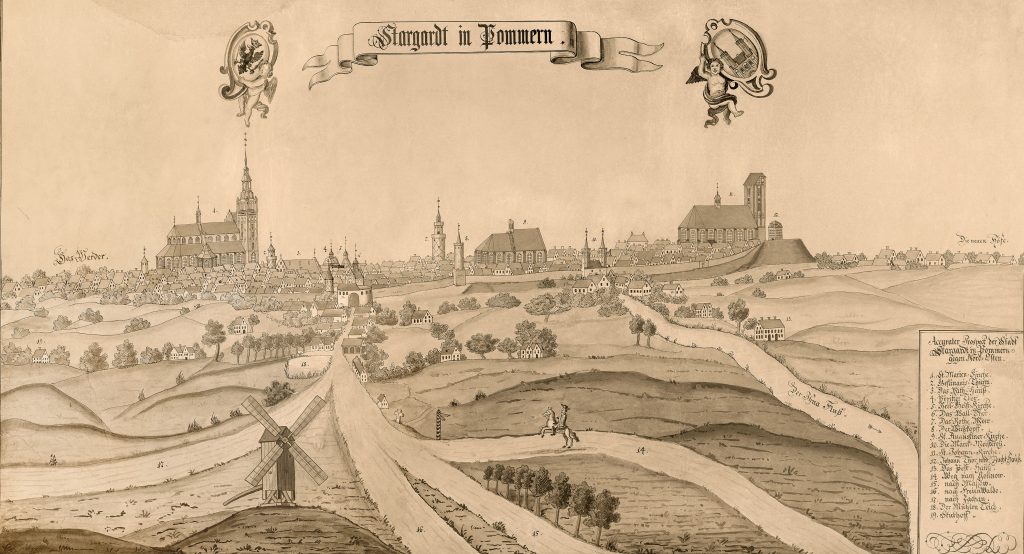
Illustration: View of Stargard from the northeast, after a drawing by R. Meyer, c. 1734
(from the collection of the Museum of Archaeology and History in Stargard)
More:
Szultka Z., Lesiński H., Łukaszewicz D., Wielopolski A. (oprac.), Historia Pomorza, pod red. G. Labudy, t. II, cz. 3. Poznań 2003.
W czasach, gdy Stargard był stolicą… O kuflu monetowym małżonków von Lockstädt w zbiorach Muzeum Archeologiczno-Historycznego w Stargardzie, pod red. M. Majewskiego, Stargard 2014.