Polish workers in the Province of Pomerania from 1871 to 1945.
From seasonal labor to forced exploitation for the economy of the Third Reich
The labor market in the German Empire, proclaimed in 1871, was characterized by a distinct wage gap between the western and eastern parts of the country, as well as between urban and rural areas. The rural depopulation (Landflucht), which escalated sharply from the peak period of industrialization, created a significant shortage of labor and forced the migration of the workforce, especially young people. These negative trends affected Prussian territories in the east in particular, to a large extent including the Province of Pomerania. As is well known, this area was characterized by a decidedly agrarian character and a rather archaic economic structure, with a relatively smaller share of industry outside of Szczecin. In the new constitutional and political conditions after 1871, this province inevitably had to play the role of a region pushed to the periphery. Because of a lack of raw materials and low population density, which was further exacerbated by emigration, these lands faced considerable difficulties in integrating into the economic circulation and the industrialization process of the Second Reich.
Instead of attempting a systemic remedy for the situation in the agricultural areas east of the Elbe, the unified German state relied on protectionism—among other things, by introducing protective tariffs in rural areas—while simultaneously opening its borders to foreign seasonal workers (Saisonarbeiter). The latter, arriving in Pomerania every year, were predominantly Poles, frequently young farmhands from the Russian and Austrian partitions (Galicia), who came there due to high unemployment, overpopulation, and a low standard of living in their places of origin. The reserve of Polish labor in the Pomeranian countryside served to offset the shortage of German workers who were also massively migrating from this province to the west (Ostflucht) in connection with the intensive development of German industry (mainly in the Ruhr Valley). The influx of this labor force into Pomerania could be easily regulated depending on the demand of local agriculture.
German authorities operated on the assumption that the wage and social conditions for seasonal workers (Saisonarbeiter) could be lower than the standards for German agricultural laborers. In many respects, Poles were exceptionally convenient economic migrants for Pomeranian agricultural entrepreneurs and large landowners (Junkers). Glad to have found work at all, they often accepted low wages and poor accommodation, irregular working hours, and patronizing—frequently discriminatory—treatment without a word of complaint. Furthermore, employers were not required to pay social security contributions for them. The way estate owners treated them was increasingly described, not only in the Province of Pomerania, as outright exploitation. Nevertheless, even with a broad interpretation of the term, this cannot be strictly classified as forced labor. After all, Poles arrived there voluntarily out of economic motives. Under German law from 1891, during the winter months, a few days before Christmas, foreign workers were required to return to their home regions. If they were apprehended within the territory of Pomerania—or Prussia more broadly—during this period, the German authorities forcibly deported them from the country. The primary purpose of this measure was to prevent Poles from permanently settling on these lands. In this context, Bogdan Dopierała rightly pointed out that the seasonality of their labor was nevertheless “in many cases apparent,” since after a two- or three-month stay at home they had to “return to their previous workplace with a West Pomeranian Junker,” and sometimes it happened that “people from the same areas, often even members of the same families, went to work in the same villages for generations.”
Pomeranian landowners were primarily interested in harvesting crews and potato pickers (especially in the areas of Far Pomerania)—temporary field workers who were no longer needed after the harvest and whom employers did not want to pay any longer. Quite a few Poles also worked at that time harvesting sugar beets, particularly in districts such as Pyrzyce, Greifswald, Anklam, Randow, Franzburg, Demmin, Rugia, Koszalin, Gryfice, Gryfino, and Usedom-Wolin. In subsequent years, especially after 1900, it turned out, however, that Polish seasonal workers, in reaction to poor treatment and low wages, often left their workplaces before their contracts expired, most frequently to take up employment with another landowner under better conditions.
The First World War, unleashed at the end of July 1914, which rather quickly transformed into a multi-year war of attrition, brought a turning point regarding the employment of foreigners in the Reich, and not just in the Province of Pomerania. In addition to utilizing the labor of foreign prisoners of war, the Germans soon began forcing Polish civilians to work in agriculture in this region as well. Individuals staying in Pomerania, unless they came from Austria-Hungary (the Austrian partition), an ally of the Reich, were strictly forbidden from returning to their home regions upon the expiration of their contracts. Most Polish workers were forced to remain on estates located east of the Elbe until the end of the war. Furthermore, the Germans initiated mass deportations of Poles from the Russian partition for forced labor. These coercive measures met with strong resistance from the population, yet at their peak in 1917–1918, there were still approximately 410,000 Poles across the entire Reich, with over 70% of them placed in rural areas. It is estimated that even tens of thousands of people of this nationality were working in Pomerania at that time, although it is often difficult to draw a line between the formal and actual voluntariness of their employment. Nevertheless, due to various legal restrictions, disciplinary measures, and regulations directed against Poles, their employment frequently took on a directly forced character, as evidenced by the growing number of escapes from Pomeranian farms over time.
It is also worth noting that out of about 40,000 Poles staying in the Province of Pomerania, nearly a quarter refused to sign employment contracts for 1918, due to poor working conditions, excessively low wages, and inadequate food supplies, among other reasons. This was accompanied by xenophobic propaganda, popular among Pomeranian residents and also inspired centrally, about the Polish element allegedly threatening the regional national cohesion of this area. Historians dealing with this issue suggest that it was precisely between 1914 and 1918 that certain mechanisms of exploitation and racism-fueled discrimination against foreign labor, especially of Slavic origin, began to take shape—not only in German agriculture—which would later be utilized by Adolf Hitler’s regime during the next war.
Following the First World War and the establishment of the Weimar Republic, ultra-nationalist propaganda directed against Polish seasonal workers arriving for employment in the Province of Pomerania—exaggerated to an extreme degree in its rhetoric—underwent further intensification. The Landrat of Słupsk even called them the “advance guard of a Polish invasion,” characterized, of course, as truly colonizing in nature. Meanwhile, in 1927, the director of the Szczecin port associations, Alfred Berger, described them as “bearers of Polish nationalist aspirations.” Despite this negative campaign fueled by various borderland associations (Grenzlandverbände), Polish seasonal workers continued to come to these lands for work, although statistically there was, of course, no comparison with the 1914–1918 period. Nevertheless, in 1919, immediately after the war, there were as many as 55,000 of them there, although five years later there were “only” over 24,000 Poles. Between 1925 and 1931, the number of German work permits for employing foreign agricultural laborers—the overwhelming majority of whom were of Polish origin—continued to drop systematically in Pomerania, which was also the result of the Provincial Labor Office reducing work authorizations year by year. This simultaneously reflected a fundamental shift compared to the pre-war period. In general, foreign workers were treated to a much greater extent merely as a reserve in the event of economic fluctuations, since employing native Germans was henceforth given a clear priority. During periods of strong economic growth in the Reich, including Pomerania, more foreigners were let in, and during times of crisis, fewer. Thus, the situation in the Pomeranian labor market during the period in question looked as follows: 1925 – 21,512 work permits; 1926 – 19,357; 1927 – 19,994; 1928 – 21,208; 1929 – 18,366; 1930 – 17,052; 1931 – 8,757. However, one must add to this approximately 3,000 to 4,000 Poles who had been staying in Pomerania for many years, a significant portion of whom lived there permanently with their families (including those of mixed nationality), sometimes even dating back to before 1914. For this reason, they were generally exempt from regulations restricting residence and work in the area. In 1928, the Polish Consulate in Szczecin reported to the Polish Ministry of Foreign Affairs that 24,000 Polish agricultural workers, primarily seasonal ones, were under its diplomatic jurisdiction. The systematic restriction of work permits by provincial authorities caused more than sporadic labor shortages in the Pomeranian countryside, particularly visible in the districts of Pyrzyce, Szczecin, Gryfice, Gryfino, Słupsk, Kamień, and Stargard. This concerned above all the periodically highly deficient harvests of sugar beets (as complained about especially by Szczecin sugar refiners and the local Chamber of Agriculture), grain crops, and potatoes.
Importantly, according to Polish law, travel for temporary work in Germany was prohibited until 1926. From the perspective of German regulations, however, Polish economic migration was legal until 1927 only if the workers were recruited by the German Workers’ Central Office (*Deutsche Arbeiterzentrale*). The rest of the arriving workforce stayed there arbitrarily and thus was not covered by the emigration convention of November 24, 1927. This document regulated the legal status of Polish workers. Under its provisions, they were placed on an equal footing with German workers regarding working conditions and remuneration (though both were meager) as well as social welfare benefits. They were also protected legally by local Polish consulates. The arbitrary actions of local authorities, landowners, and entrepreneurs were thus effectively curbed by nationwide framework regulations.
After Hitler came to power in Germany in 1933, despite the declared racism-fueled aversion to foreigners, the long-term effects of the Great Depression and the autarkic needs of the economy—especially following the implementation of the Four-Year Plan in 1936—made the employment of foreign workers an absolute necessity. In the case of Pomerania, this was compounded by an acute shortage of labor in the countryside and the associated need to transition to extensive farming methods. Despite these efforts, including unsuccessful attempts to settle Hungarian or Slovak Germans there, the influx of Polish agricultural workers to these areas could not be eliminated, though it was no longer on the same scale as before. Furthermore, particularly after 1936, a period of intensive preparation for war by the Nazi regime, Poles began to be engaged for seasonal work in the countryside once again. In addition, in 1937 the Polish authorities consented to a renewed, more mass-scale dispatch of domestic workers to the Reich. In the spring of 1939—a few months before the outbreak of the war—there were officially 727 Polish contract workers and 85 individuals of this nationality working as permanent domestic servants directly in Pomeranian agriculture on indivisible hereditary farms. Interestingly, much larger groups in this context at the time were Italians (2,450), Yugoslavs (2,167), Hungarians (3,035), and Slovaks (1,058).
Following the Nazi German invasion of Poland and the outbreak of World War II in September 1939, due to labor shortages in industrial and agricultural enterprises crucial to the war effort, Pomerania quickly became a destination to which thousands of Polish prisoners of war and forced laborers were brought.
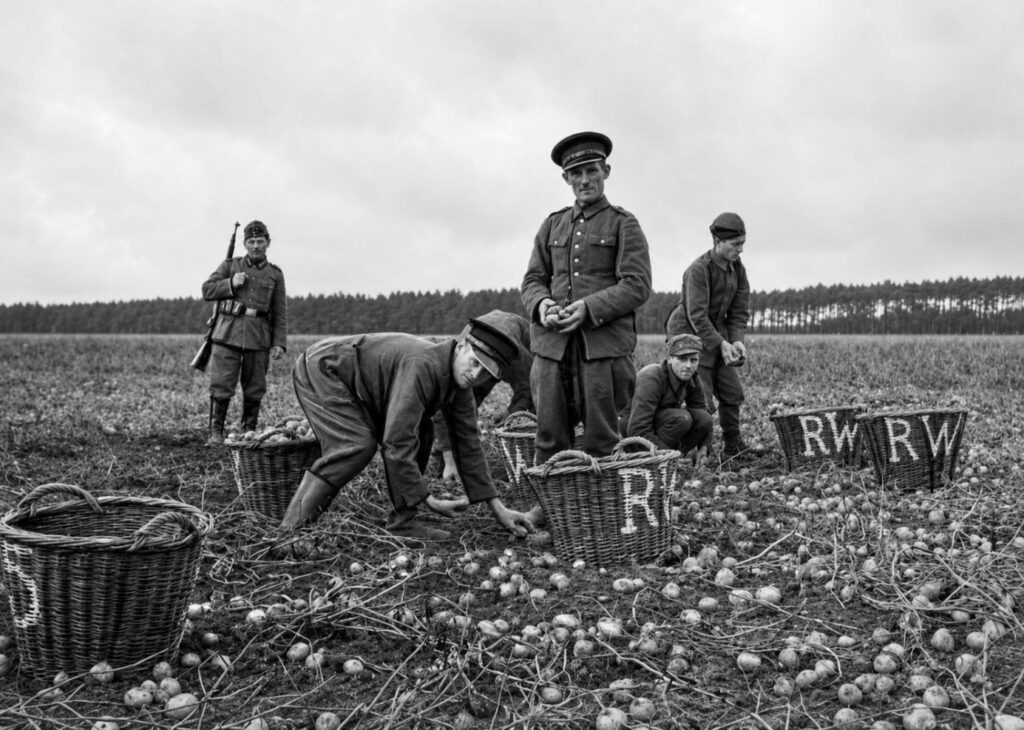
Polish prisoners of war harvesting potatoes in September 1939, with a German soldier guarding them on the right (NAC, 2-116)
Over time, the local labor pool expanded to include workers from almost all of occupied Europe. Thus, Poles from the occupied Pomerelia (Gdańsk Pomerania) and Greater Poland were brought to the provincial capital of Szczecin as early as September 18, 1939. By the beginning of the following year, their number in the city had already reached approximately 15,000 employees. They predominated among local foreign workers who over time—especially after 1943—accounted for as much as 10 percent of the city’s population. They were employed primarily in the port of Szczecin, the shipbuilding industry, the Stoewer automobile factory, the paper mill in Skolwin, and many smaller plants, while women were frequently engaged in restaurants and as domestic help. Major camps of this type in Szczecin at the time included *Pommersche Zuckersiederei*—located on Łasztownia by the sugar refinery, *Merkurlager*—belonging to the *Stettiner Oderwerke* shipyard, *Gemeinschaftslager Strom-Stolzenhagen* at 18 Nad Odrą Street—a housing facility for workers employed at the ironworks site, and *Pomolager*—associated with the *Pommersche Motorenbau* aircraft engine manufacturing plant in Załom, which employed as many as 4,000 people.
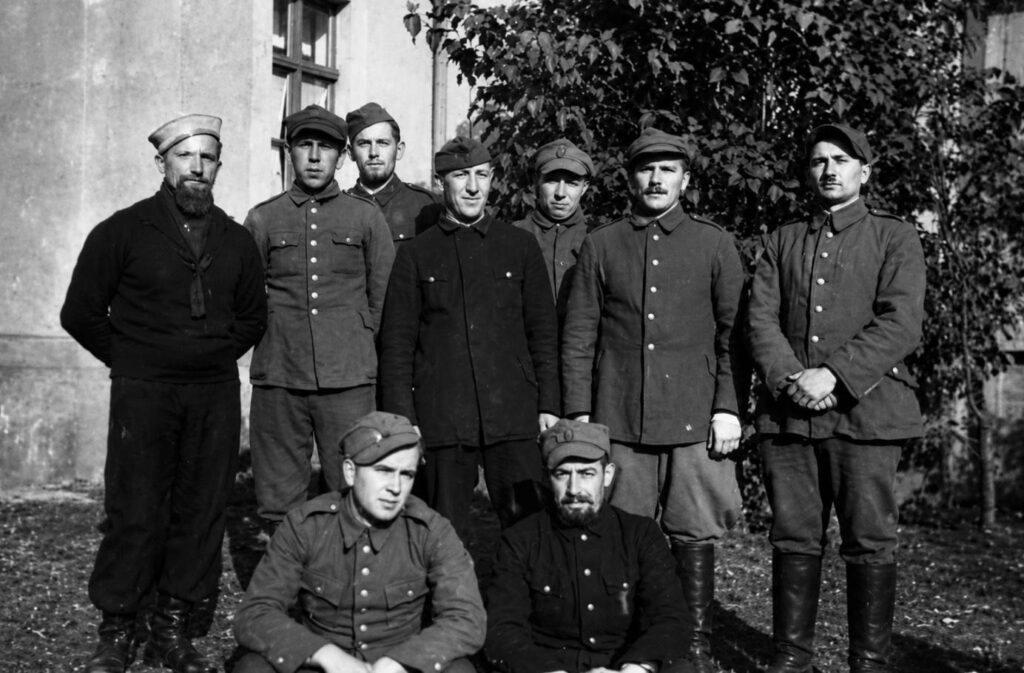
A group of Polish prisoners of war from the Stalag II C camp in Greifswald, assigned to work in Szczecin. The photo was taken in 1941 (photo from the collection of the Pomeranian Library in Szczecin).
For example, in the district of Pomorzany (Pommerensdorf) alone, there were at the time at least several German forced labor camps—more precisely, collective accommodation camps, which were the most statistically common type back then, consisting of wooden barracks capable of housing up to 300 people. Thus, Poles were employed there, for instance, in the Gemeinschaftslager Tiergarten camp, established in late 1939 (liquidated in mid-1941) and located at 18 Chmielewskiego Street, and in the Merkurlager 4-Am Lenzweg camp, founded near the gasworks in 1940 (functioning until the end of August 1944). Camps of the Gemeinschaftslager type were also located in buildings at 26 Chmielewskiego Street and 56/57 Milczańska Street. Furthermore, one can mention the Gemeinschaftslager-Kosakenberg camp at 29 Powstańców Wielkopolskich Avenue, the Lager Fulmina located at 13a Tama Pomorzańska Street, and the camp at 8 Powstańców Wielkopolskich Avenue, where prisoners, including Poles, worked in the Heinrich Hemerling suitcase factory. Overall, during the war period, Szczecin grew into a true epicenter of forced labor and prisoner-of-war camps in Pomerania. Bogdan Frankiewicz, a researcher of this issue, estimates that their number reached as many as 150, which only testified to the significant role of the foreign workforce in the city’s wartime economy.
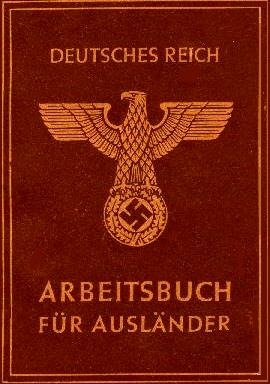
Cover of the work book (*Arbeitsbuch*) of a Polish forced laborer (author’s private collection).
Meanwhile, between 1939 and 1945, throughout the entire Province of Pomerania, there were over 225,000 foreign forced laborers and 81,000 prisoners of war. Among them, the largest group consisted of Poles, whose number reached even over 116,000 in the final period of the war. Polish workers—not only those exploited for agricultural labor on farms scattered across Pomerania (for example, Polish prisoners of war were used for field work in the Stargard, Saatzig, or Pyrzyce districts)—were often assigned to exhausting, backbreaking labor performed even in extremely difficult weather conditions. Not infrequently, they could only count on starvation rations, and their living accommodations were less than adequate.
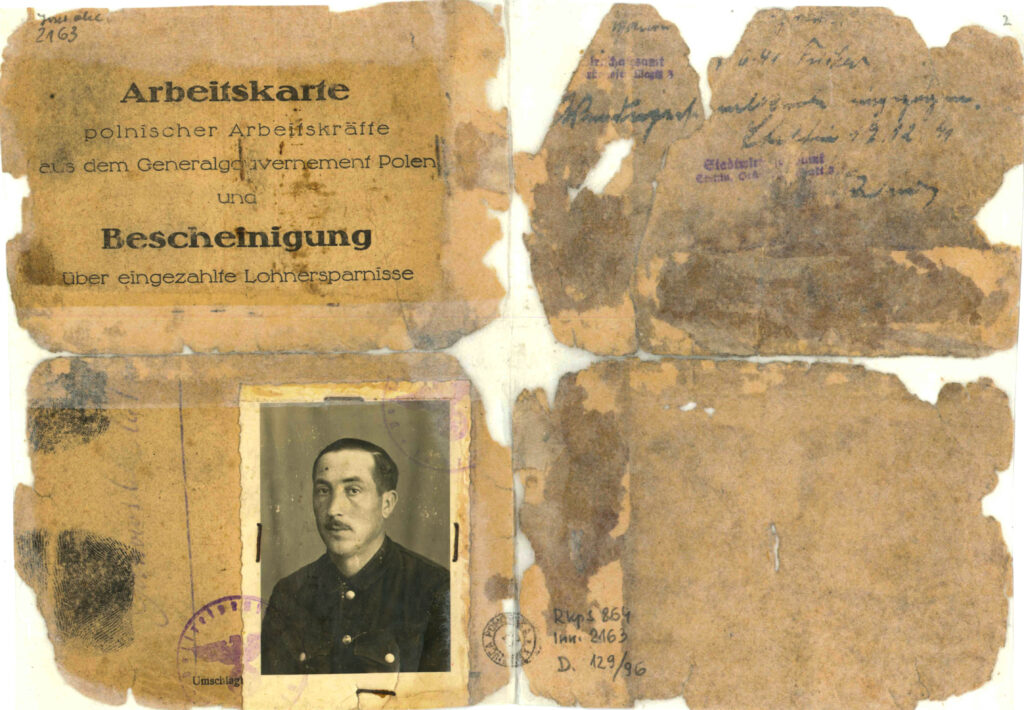
The labor card of Aleksander Janowski, a Polish prisoner of war from the Stalag II C camp in Greifswald, assigned to work in Szczecin. Entries by German offices from 1941 to 1943 are visible (from the collection of the Pomeranian Library in Szczecin).
Poles were subjected to continuous racial discrimination (they were marked with a purple “P” on a yellow background, were prohibited from using public transport or public utility buildings, were subject to a curfew and a ban on contact with German women, were not allowed into air-raid shelters, and had their religious practices restricted, etc.) and severe repression. For even the smallest “infractions,” they were beaten, sent to labor education camps under special regulations, or punished directly with death.
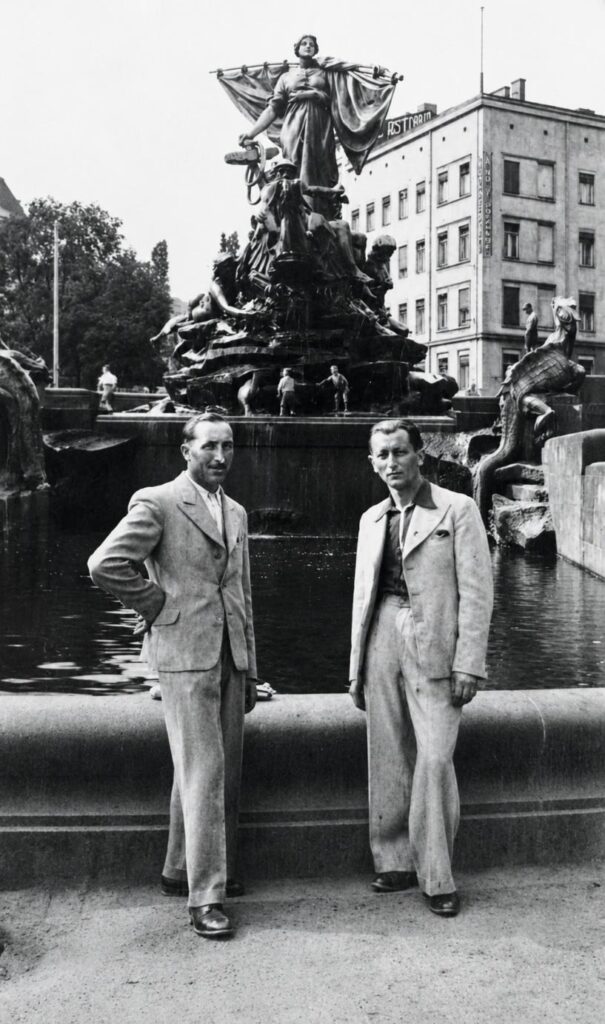
Forced laborer Aleksander Jankowski with a colleague at the Sedina/Manzelbrunnen monument, the most popular spot for taking photos in Szczecin (from the collection of the Pomeranian Library in Szczecin).
One such strictly guarded labor education camp that gained a particularly infamous reputation was the Straflager Hägerwelle in Police (under the supervision of the Szczecin Gestapo). Prisoners were subjected to penalties ranging from a few days to a few months of “re-education,” for example, for escaping from a workplace or leaving without authorization. In Police, which had been part of Greater Szczecin (Großstadt Stettin) since October 1939, a subcamp of the Stutthof concentration camp operated from June 1944 alongside the synthetic petrol plant (Hydrierwerke Pölitz), housing nearly 3,000 prisoners, including many Poles. A network of collective accommodation camps for several thousand foreign forced laborers and prisoners of war was established around the factory area, including the Pommern, Nord, Tobruk, and Wullenwever camps, as well as Dr. Dürrfeld’s camp and a residential penal company on the steamship Bremerhaven (Wohnschiff Bremerhaven), primarily for Polish workers, anchored at the mouth of the Oder River since the turn of 1939/1940. This was a horrific site of martyrdom and backbreaking labor, where SS guards brutally tortured prisoners and drove them to death (one of the first victims of the Bremerhaven was Stanisław Wasilewski, originally from Zgierz). In the autumn of 1943, however, this camp was liquidated due to the Kriegsmarine‘s growing demand for such floating units. No later than the spring of 1945, in connection with the evacuation of Szczecin and the entry of the Soviet army into the Province of Pomerania, the forced labor camps that had existed there until then—holding not only Poles—ceased to function. To this day, those who are still alive have not lived to see fair compensation for the years of enslavement, physical exploitation, and “lost youth”…
Bogdan Dopierała, Polscy robotnicy sezonowi na Pomorzu Zachodnim w dwudziestoleciu międzywojennym, „Szczecin” 1958 nr 1-2.
Bogdan Frankiewicz, Praca przymusowa na Pomorzu Zachodnim w latach II wojny światowej, Wydawnictwo Poznańskie: Poznań 1969.
Mark Spoerer, Praca przymusowa pod znakiem swastyki. Cudzoziemscy robotnicy, jeńcy wojenni i więźniowie w Niemczech i okupowanej Europie w latach 1939–1945, tłum. Ł.M. Plęs, Gdańsk: Muzeum II Wojny Światowej 2015.
Praca przymusowa podczas II wojny światowej. Pamięć i konsekwencje, red. Wojciech Wichert, Tomasz Ślepowroński, Szczecin-Warszawa: Instytut Pamięci Narodowej 2025.