


Fortress of Szczecin
From the end of the 15th century and the Italian Wars onward, Europe saw a rapid increase in the number of modern fortifications designed to withstand sieges carried out with advanced weaponry, above all artillery. The construction of defensive works went through successive phases over the following decades: from the so-called Old Italian style, through the Old Dutch, to the New Dutch style. This reflected the dynamic development of siegecraft, which is why the art of fortification advanced most rapidly in countries that experienced warfare on their own territory during the 16th century. Foremost among them were the United Provinces (today’s Netherlands), which from 1568 found themselves in an almost permanent state of conflict with Spain (the Eighty Years’ War).
The Duchy of Pomerania, which experienced a period of peace throughout this century, did not generate the need for widespread fortification. However, we must remember that at that time the construction of defensive works was not only a matter of military necessity but also a symbol of a ruler’s prestige. This was most likely the foundation of Duke John Frederick’s plans, during whose reign (1569–1600) designs were drawn up to equip Szczecin with modern fortifications. Unfortunately, very little of these plans came to fruition.
In the two versions of the engraving by Georg Braun and Frans Hogenberg (ca. 1580 and ca. 1600), published in successive editions of Civitates Orbis Terrarum, we still see Szczecin enclosed by its medieval walls. As a sign of the duke’s unrealized plans, one can discern an earthen rampart running in a semicircle around the walls and connecting to the Oder in the north and south. In the northwestern part, a small bastion is also visible (most likely also earthen, reinforced with fascines), upon which two cannons are positioned. On the inner side, it is equipped with a modest palisade and a gate.
Such a “fortified” city could not withstand a siege; this was one of the reasons behind Duke Bogislaw XIV’s decision not to resist the Swedish forces that appeared before Szczecin in the summer of 1630. King Gustavus Adolphus’s army was one of the best-organized and most effective forces of the Thirty Years’ War (1618–1648). Within its ranks were not only regular line troops but also military architects, engineers, sappers, and artillerymen. The policy of neutrality that the Pomeranian dukes attempted to pursue during this conflict ended in complete failure (see more in the text on the Thirty Years’ War in Pomerania).
The capture of Szczecin by Swedish troops in 1630 marked the beginning of a new chapter in the city’s history, which lasted (formally) until 1720. The Swedes almost immediately began designing new fortifications, which were implemented at a rapid pace. On the manuscript plan by Portius, preserved in the Krigsarkivet in Stockholm, we can see that the initial ideas envisioned extensive earthworks that took into account the topography of the surrounding area. This plan, although not fully realized, was carried out relatively quickly.
The results of these works can be seen in the engraving by Matthaeus Merian, published, among others, in Martin Zeiller’s Topography of Brandenburg and Pomerania in 1652. This bird’s-eye view encompasses the entire city and, in its overall composition, is based on the earlier Braun/Hogenberg plan. However, it shows how Szczecin ultimately looked after more than a decade of fortification. The city was equipped with nine defensive works, such as bastions, ravelins, and a hornwork. The main strengthening of Szczecin was directed toward the most accessible approaches to the city, namely from the north and west. Movement into and out of the city was limited primarily to two gates — the Mill Gate (Młyńska) in the north and the Passau Gate (Pasawska) in the west — although additional passages were left: a northern one opposite the Maiden Gate (Panieńska), leading through the line of fortifications toward Grabowo, and a southern one across a small bridge toward Pomorzany (directly opposite the Holy Spirit Gate). The entire system was further secured by a wet moat.
The Swedish fortifications would not be complete without mentioning the additional defensive works. While the Szczecin fortress itself was surrounded by earth ramparts faced with brick, further outer defenses were constructed around the city, consisting at least partly of earthworks. These included above all the southern economic hinterland — gardens, farmland, and windmills in the area of today’s Pomorzany — as well as an independent star-shaped redoubt (Sternschanze) near the then village of Turzyn, connected to the fortress core by a covered road, and finally Łasztownia. Through this island ran the road to nearby Dąbie (at that time a separate town), which the Swedes also surrounded with modern fortifications.
After the war, the Swedish garrison of Szczecin numbered about 1,000 soldiers, and over the following years this figure doubled. They were supported by 11 companies made up of townsmen: 8 assigned to the fortress itself and 3 to Łasztownia. Each was commanded by a captain. The burden of maintaining the garrison fell on the townspeople, who, in addition to providing quarters, were subjected to a special “rampart tax” to finance the upkeep of the fortifications, as well as to ad-hoc levies — for example, during the Swedish Deluge, when Szczecin and Stralsund had to pay a special tax of 100,000 thalers.
For nearly a century of Swedish rule, additional — less durable and sometimes makeshift — defensive works were erected around the city. This stemmed from the fact that, under the Treaty of Westphalia ending the war, the former Duchy of Pomerania was divided between Sweden and Brandenburg. Szczecin, controlling the mouth of the Oder, was granted to Sweden; the Brandenburg electors never accepted this, since the Oder was a crucial communication and trade route linking Silesia, Brandenburg, and Pomerania, and via the Warta River also with the Polish–Lithuanian Commonwealth. Thus, the end of one war became the prelude to further conflicts, this time on a more local scale.
During the Swedish period, Szczecin was attacked several times by Imperial and Brandenburg forces, usually supported by their allies. In 1657, the area around the city was plundered by Polish troops under Stefan Czarniecki, who was marching towards Denmark, striking at Swedish possessions. Two years later, in 1659, 14,000 Austrians under Field Marshal Jean-Louis de Souches, together with the Brandenburgers, laid the first siege of the city. It was repelled by the fortress commander, Paul Würtz, who ensured that supply routes along the Oder remained open and even managed to seize a transport of provisions intended for the besiegers.
Once again, the Brandenburgers approached the city in the summer of 1676, during the Swedish–Brandenburg War. The siege was suspended over the winter and resumed in the summer of 1677. This time, the combined coalition forces (Brandenburg supported by the Danes, troops from Lüneburg, and Croatian mercenaries) drew lessons from their earlier, unsuccessful attempts to capture Szczecin. The waterway was blocked; artillery fire was launched from the Oder using specially prepared barges, and the besiegers advanced towards the city with saps and tunnels, first seizing the previously mentioned Sternschanze.
At that time, the city was defended by a garrison of 1,100 soldiers along with 11 companies of townsmen. During the siege, the defenders were reinforced to a total of 3,300 infantry, 700 cavalry, and 125 artillerymen (the latter number being clearly insufficient). The fortress capitulated in December 1677, and in January of the following year, Elector Frederick William ceremoniously entered the city.
The months-long siege had a severe impact on the city’s built fabric. Streets were buried under rubble (which delayed the ceremonial entry of the conqueror into the ducal castle of Szczecin), and a third of the houses were either destroyed or rendered uninhabitable. Many valuable cultural assets in churches and libraries were burned, while others were looted and taken to Berlin. Apart from the devastation of the Second World War, the Brandenburg siege caused the greatest damage in the history of Szczecin.
Frederick William did not enjoy possession of the city for long. The complex system of alliances, with France (allied with Sweden) playing the leading role, meant that after two years the Brandenburg garrison had to leave Szczecin, which returned to Swedish control.
The years between 1679 and 1713 marked a period of gradual decline of Szczecin’s fortifications. The city struggled for a long time to recover from the devastation, and short-term reliefs from taxes or quartering duties brought little improvement. During this time, the Swedes drafted several design plans, but none were implemented. When the Prussians occupied the city in 1713 and inspected the fortifications, they decided that immediate construction of new defenses was necessary, as the old ones were outdated and beyond repair.
The presence of Prussian troops in Swedish-held Szczecin was tied to the ongoing Great Northern War and a clever maneuver by King Frederick William I of Prussia. The Kingdom of Prussia, the “successor” of the Brandenburg Electorate (in 1701 Elector Frederick III crowned himself King in Prussia and ruled as Frederick I), had maintained neutrality during the war. In 1713, the siege of Szczecin by Saxon and Russian forces threatened the city with capture and the imposition of new contributions. This became an argument for the townspeople and the Swedish fortress commander to “invite” the Prussians, who were operating nearby on their side of the border, as well as the Duke of Holstein, to enter the city for protection and temporary occupation. In October 1713, 1,600 Prussian soldiers entered Szczecin, and within just over a year their number grew to 4,500. The Holstein troops were forced to withdraw, and thus – despite protests from the Swedish king – Szczecin remained in Prussian hands until 1945. The arrangement was formally confirmed in 1720 by the Treaty of Stockholm.
The aforementioned inspection of the city walls had its consequences – the Prussians began drafting plans, which after 1720 were put into effect. The chief architect of Szczecin’s fortress in its so-called Old Prussian form was Gerard Cornelius von Walrave. Over the course of 20 years, up to 1740, one of the largest fortresses in the Prussian state and in Northern Europe was constructed.
The city core was encircled with multi-layered, star-shaped ramparts; the medieval walls were demolished, and the bricks reused as building material. The fortifications were reinforced with three forts: Fort Leopold to the north, Fort Wilhelm to the northwest, and the independent Fort Prussia, located near the site of the former Sternschanze.
The last of these was a particularly interesting project: designed as a self-sufficient town capable of withstanding a prolonged siege. It housed craft workshops, barracks, a hospital, and the full infrastructure needed to allow the garrison to live relatively comfortably even during a blockade. It was meant to be connected to the city by a covered passage, which – it seems – was never completed (instead, an avenue lined with double rows of trees on both sides was laid out). To make space for this newly designed work, the village of Turzyn was relocated to its present location.
In the course of the 18th century, the defensive qualities of the fortress were never put to the test in practice; the Seven Years’ War, which affected Pomerania, fortunately bypassed Szczecin. It was only the defeat of Prussia in battles against Napoleonic France at Jena and Auerstädt (1806) that placed the Szczecin garrison in the face of a potential siege. On October 30, 1806, this one of the largest Prussian fortresses surrendered without a fight to a mere 800-strong cavalry brigade under General Lasalle. These small French forces were swiftly reinforced by about 10,000 coalition soldiers (including Hessians and Bavarians), who soon marched eastward against Russia.
Such numerous billeted troops inevitably had a negative impact on the well-being of the townspeople, all the more so as Napoleon imposed a heavy contribution on Szczecin (2.5 million thalers, later reduced to 1 million). Moreover, the city’s incorporation into the French sphere of influence blocked maritime contacts with England. The city itself could not accommodate the entire army; for this reason, a large military camp was established at the site of today’s Unii Lubelskiej Street.
In February 1813, the anti-Napoleonic coalition forces approached Szczecin and Dąbie, beginning a siege that lasted until December. The Battle of Nations, fought in October of that year near Leipzig and ending with Napoleon’s defeat, made it pointless to maintain garrisons in fortresses deep inside Europe. The French evacuated Szczecin, and at the same time all the lands of the former Duchy of Pomerania were united under the Hohenzollern monarchy. For the city at the mouth of the Oder, a period of 130 years of peace began.
The recovery of the Szczecin fortress made it necessary to strengthen and rebuild it (the so-called New Prussian period). From 1820 onward, part of the II Army Corps (specifically elements of the 2nd Infantry Division) was stationed in the city, along with the headquarters of both the corps and the division. Among the units present (which varied over time) were: the 5th Infantry Regiment, the 2nd Artillery Regiment, the 2nd Reconnaissance Detachment, and the 2nd Medical Detachment.
The final transformation in the history of the Szczecin fortress came from external developments. In 1871, Prussia defeated France in another war, while at the same time achieving the unification of the German states into the Second Reich. Modern methods of warfare—especially the ability to bombard fortresses from many kilometers away—made it necessary to rethink traditional fortification systems. Defensive works had to push besiegers far away from the fortress core, something that was not possible in Szczecin. Moreover, after the unification of Germany, the capital of Pomerania lost its strategic importance, becoming instead an inland city. Under these circumstances, in 1873 the state authorities granted permission for the demolition of the fortifications and for the city to purchase the reclaimed land. The process of acquisition took place gradually due to high costs. On the former fortress grounds, particularly along the Oder River, new representative districts and public buildings were erected—today forming part of the Wały Chrobrego (Chrobry Embankment) ensemble in Szczecin.
Today, only a few remnants of Szczecin’s former fortifications can still be found within the cityscape. From the Old Prussian period, two beautiful gates have survived (the Royal Gate and the Port Gate); the terraces of the Wały Chrobrego, retaining walls along Piastów Street, former barracks on the site of Fort Prusy, and the casemates at Tobrucki Square. The history of the Szczecin fortress is not currently a subject of focus for the city authorities, and in museum narratives it appears only sporadically and “incidentally.”
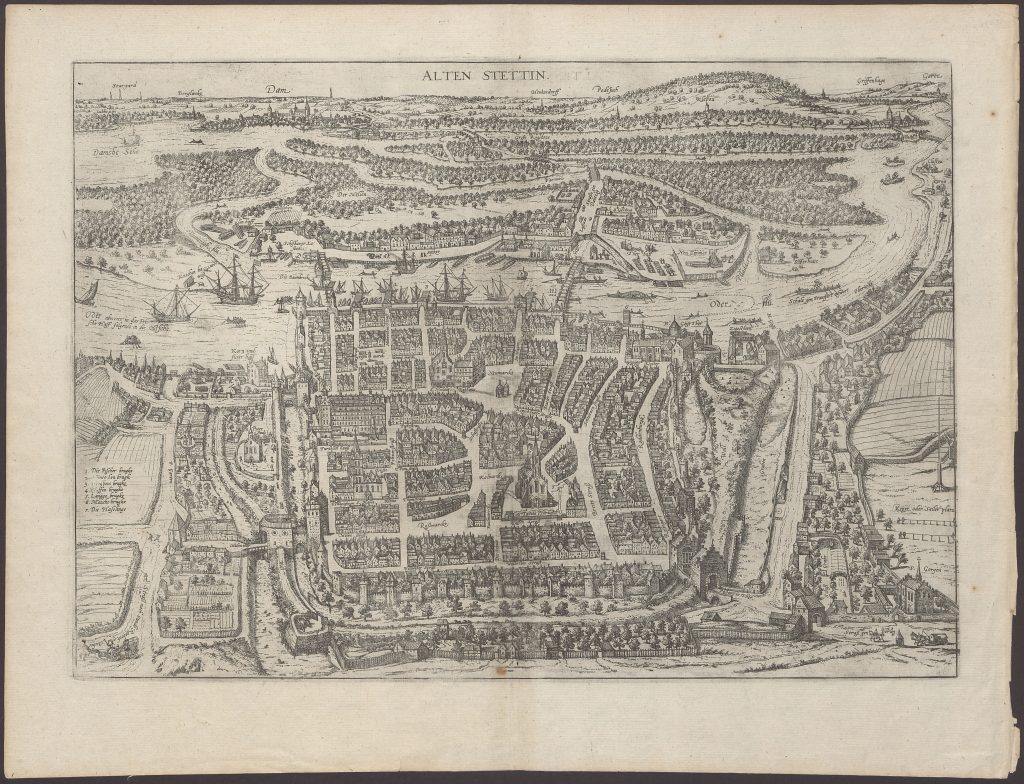
Ryc. 1 – A bird’s-eye view of Szczecin, the so-called Braun & Hogenberg engraving, ca. 1600 (zbiory Biblioteki Głównej US, Ikn. 149)
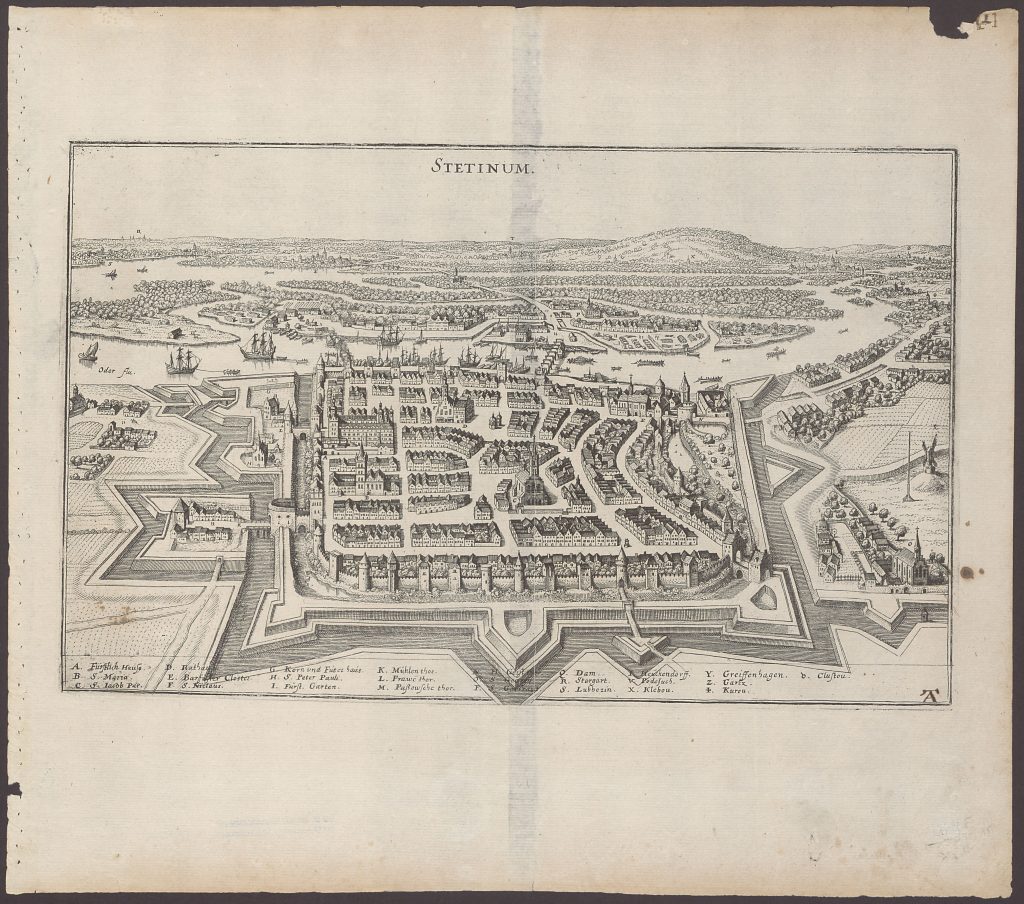
Ryc. 2 Szczecin under Swedish rule, after M. Merian, 1652 (zbiory Biblioteki Głównej US, Ikn. 150)
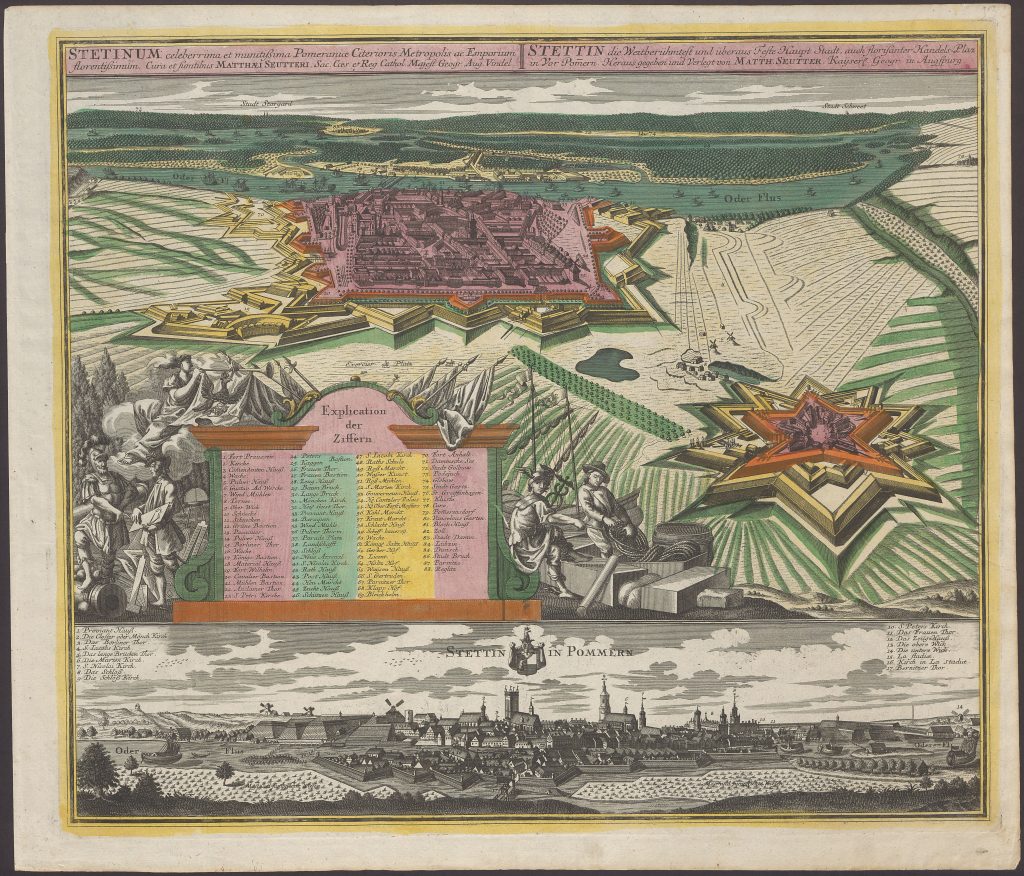
Ryc. 3 Prussian fortress of Szczecin, M. Seutter, ca. 1745 (zbiory Biblioteki Głównej US, Ikn. 152)
More:
Pomorza Zachodnie poprzez wieki, red. J.M. Piskorski, Szczecin 1999.
Skrycki R., Gerard Cornelius von Wallrave – architekt szczecińskiej twierdzy, w: Szczecin – historię tworzą ludzie, red. K. Rembacka, Szczecin 2010, s. 60–70.
Zilm F.-R., Geschichte der Festung und Garnison Stettin, Osnabrück 1988.
Radosław Skrycki