


The conflict in the Pomeranian Bay in the years 1985–1989 and after 1990
The genesis of the conflict should be sought in the inconsistent decisions of the Potsdam Conference of August 2, 1945. At that time, only the land-based demarcation between the Soviet Occupation Zone in Germany and the territories placed under Polish administration—which Warsaw had considered a permanent acquisition of the Polish state from the beginning—was established. On this basis, demarcation was carried out in the autumn of 1945; however, the mixed Polish-Soviet commission did not establish the course of the maritime border, lacking both the competence and the appropriate delegations in the decisions of the Big Three. This was supplemented after the establishment of the German Democratic Republic, which on July 6, 1950, concluded the Treaty of Zgorzelec with Warsaw, recognizing the Potsdam line as the existing Polish-German border. The executive document, under which certain border adjustments were made and the maritime border was delimited for the first time, became the Frankfurt Act of 1951. In accordance with the maritime law of the time, the belt of territorial waters of both states in the Pomeranian Bay was 3 nautical miles wide, and this state of affairs persisted until the second half of the 1970s. During this period, the development of the maritime economy of the Polish People’s Republic led to more intensive use of the water area. Through great financial outlay, by 1969 the northern approach channel to Świnoujście, located north of the Polish territorial sea, was deepened, enabling safe navigation to the Szczecin-Świnoujście Seaport Complex for larger vessels. Both neighboring states also had serious plans related to the exploitation of crude oil and natural gas from the submarine shelf, the demarcation of which had to be carried out beforehand. This took place under the agreement of 1968, but an oversight on Warsaw’s part resulted in its unfavorable content, which ignored Polish investments in the seabed of the Pomeranian Bay, leaving more than 18 nautical miles of the northern approach channel to Świnoujście on the East German shelf. This came back to haunt Poland at the end of the following decade, when the Polish Steamship Company began introducing vessels that required a new deep-water anchorage. In accordance with international law, the Polish maritime authorities applied for permission to prepare it from the owner of the seabed—the GDR maritime administration. East Berlin never granted such permission. This was accompanied by a paradoxical situation in which part of the Pomeranian Bay seabed belonged to East Germany, the shipping lane dredged into that seabed was de facto Polish, and the waters above them were unclaimed.
The passivity of the central authorities caused the experts associated with the director of the Maritime Office in Szczecin (UMS), master mariner Józef Stebnicki, who had been initiating active measures to defend Polish interests since early January 1985, to come to the fore. In letters addressed to the Office of Maritime Economy (UGM), he demonstrated the negative consequences that the unilateral actions of the GDR would bring. He drew attention to the bad faith of East Germany, which drew its maritime border with the FRG and Denmark in the Bay of Mecklenburg in a completely different manner, pushing it south and respecting the shipping interests of those states. He sent specific proposals for the delimitation of waters in the Pomeranian Bay that were intended to lead to a similar solution. It should be emphasized that the work done at the UMS was excellent, as J. Stebnicki’s proposals from February 1985, after four years of conflict, were fully incorporated into the Polish-East German agreement. His activity, including personal visits to Warsaw, led the government of the Polish People’s Republic on February 20, 1985, to issue an unprecedented diplomatic note to East Berlin—given the conditions of how the socialist community functioned—rejecting the unilateral delimitation of the waters of the Pomeranian Bay carried out by the GDR.
Soon-to-commence negotiations between Polish and East German experts did not lead to a rapprochement of views, and both sides remained in their positions. The actions of the GDR authorities proved to be extremely serious, which is why their causes should be sought not only in the prestigious rivalry for the second position after the USSR in the Eastern Bloc—though this undoubtedly became possible as a result of the weakening of the Polish People’s Republic, which was bogged down in a political and economic crisis in the 1980s. The economic factor also played an important role. Since the 1970s, East German ports such as Rostock, Warnemünde, Sassnitz, and Wismar had been enriching themselves with increasingly modern transshipment infrastructure. A relatively well-developed network of highways and a convenient location at the crossroads of East and West, by “blocking” the port in Szczecin and Świnoujście, would have allowed the GDR to take over a large portion of international transport for Central-Eastern and Southern Europe. From the early 1980s onward, the ferry terminal in Mukran (on Rügen) was built with extreme intensity, designed by assumption to take over transit from the USSR in the event of an uncertain situation in Poland. Should the aggressive actions of East German warships also be explained this way? In the shadow of negotiations between 1986 and 1988, over 180 incidents took place in the Pomeranian Bay. East German patrol boats pulled up alongside Polish yachts, causing damage and threatening navigational safety, demanding that they leave the waters claimed as East Berlin’s territorial sea. The same was expected of merchant vessels of various flags heading to the Szczecin-Świnoujście Seaport Complex (ZPS-Ś) or waiting to be lightered at anchorage no. 3. This could hinder the operation of ZPS-Ś and create the impression that the roadstead was being illegally exploited by the Polish side, while also prompting foreign shipowners in particular to choose other ports of the western Baltic.
At that time, Stanisław Miśkiewicz, First Secretary of the Provincial Committee of the PZPR in Szczecin, actively joined in defending Polish interests, amplifying J. Stebnicki’s voice through party channels. Their close cooperation guaranteed, on the one hand, appropriate substantive input, and on the other, enabled direct contact with the central party and state elites. This became very important in the period 1988–1989, when the conflict entered its final phase and intensive negotiations were underway between the Polish People’s Republic and the GDR. It was then that a series of very interesting and extensive studies were produced in the Szczecin center regarding proposals for a resolution of the dispute with East Berlin that would be favorable to Poland. An interesting aspect of this was the cooperation of various circles in Western Pomerania, not always close to the authorities. Overcoming mutual resistance, they found a common language to exchange views that built the Polish argumentation for a positive resolution of the conflict, creating social pressure on the central authorities. The platform for action became the Maritime Council of the PAX Association, established in 1987, and it was attended by local scientists and a distinguished group of specialists, including Alfons Klafkowski, President of the Constitutional Tribunal. They were joined by independent Catholics gathered in the Szczecin Catholic Club, who, together with Szczecin scientists and maritime experts, formed the Club for Environmental Formation and Protection. Together, they organized Maritime Assemblies, where from 1988 onwards the topic of the conflict and ways to resolve it was frequently discussed. Demands calling on the authorities to defend Polish interests in the Pomeranian Bay were included in a letter sent to Gen. Wojciech Jaruzelskiego by dockworkers from the Szczecin-Świnoujście Seaport Complex who went on strike in August 1988. Earlier still, in 1986, Solidarity opposition circles in Szczecin significantly contributed to breaking through censorship decisions banning information about the conflict with the GDR. This was handled by the local underground press, most extensively by the magazine “Obraz.” It published maps presenting the essence of the conflict, thoroughly outlined its genesis, described current aggressive actions of the East German fleet, reported on discussions by scientists and maritime experts, and frequently accused the state authorities of a lack of proper interest in the issues of Western Pomerania. Eventually, the subject of the conflict even made its way into the homilies of the Ordinary of the Diocese of Szczecin-Kamień, Bishop Kazimierz Majdański. At one point, an unprecedented synergy of actions—for the conditions of the 1980s in the Polish People’s Republic—could be observed, where a bishop, local Catholic politicians, a PZPR secretary, workers of enterprises related to the maritime economy, underground Solidarity activists, scientists, and experts all cooperated regarding the conflict in the Pomeranian Bay. Therefore, unlike in the rest of Poland, the topic of the dispute with the GDR was known to a broader segment of society in Western Pomerania.
The circumstances that led to the breakthrough in Polish-East German contacts regarding the conflict remain unexplained to this day. Negotiations got off the ground in the spring of 1988, following a meeting between Erich Honecker and Wojciech Jaruzelski in Wrocław. They were accompanied by a decisive change in the stance adopted by the GDR, which appears to have been related to the general political situation in the Eastern Bloc, German-Soviet relations, and the internal situation in both the Polish People’s Republic and the GDR. The lack of support from the SED (Socialist Unity Party of Germany) for Mikhail Gorbachev’s policies and the quest for a way forward by W. Jaruzelski’s team meant that, from the perspective of a Moscow immersed in perestroika, Warsaw became much closer than an East Berlin stuck in Brezhnevian dogmatism. Contrary to earlier declarations, East German negotiators agreed to leave the entire northern shipping lane and all anchorages on the Polish side or in the open sea. They were also excluded from the GDR’s shelf area and fishing zone, the boundaries of which were shifted eastward as compensation. It was also agreed that the elements of the maritime infrastructure of the Szczecin-Świnoujście Seaport Complex (shipping lanes and anchorages) would not be included in the future exclusive economic zone of the GDR, should that state decide to establish one. All of this was incorporated into the Agreement between the Polish People’s Republic and the German Democratic Republic on the delimitation of maritime areas in the Pomeranian Bay, signed on May 22, 1989. On that day, the four-year open conflict between the Polish People’s Republic and the GDR over the course of the common maritime border came to an end.
The issue of Szczecin and the Pomeranian Bay after 1945
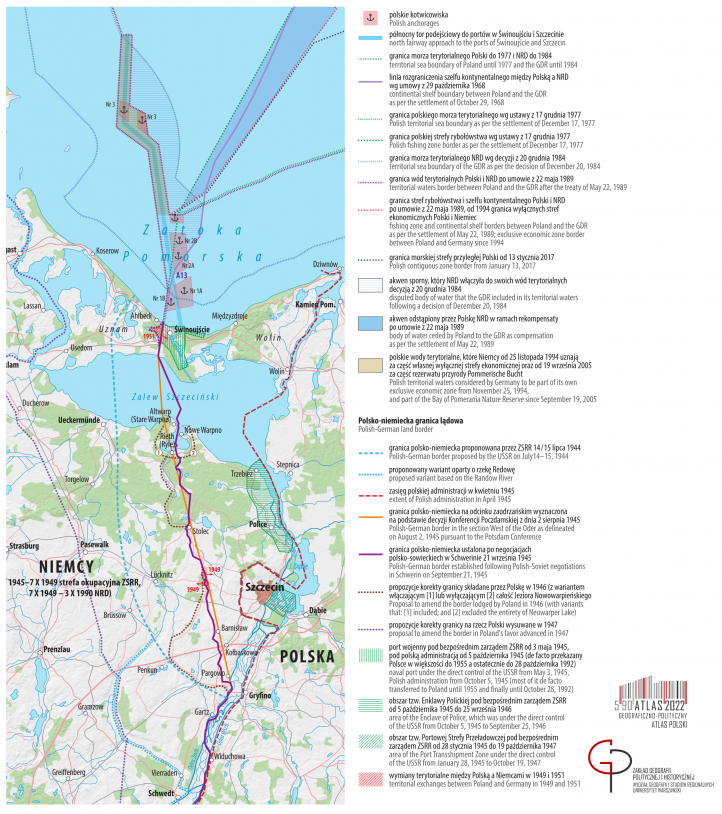
Paradoxically, the conclusion of the aforementioned agreement—which, incidentally, alongside the Polish-German treaties of 1950/51 and 1970, became the basis for the Border Treaty between Poland and a reunited Germany in 1990—did not end the controversies surrounding this water area. They flared up anew under different, post-Cold War international conditions and with the differing, unequal potentials of both neighbors. In 1994, the authorities of the FRG unilaterally and without consulting Warsaw established an exclusive economic zone in the Baltic Sea, violating the 1989 agreement (and de facto the 1990 border treaty) by incorporating areas where the northern approach channel to Świnoujście and deep-water anchorage no. 3 were located. The surprised Polish authorities responded in 1995 with diplomatic notes of protest and undertook belated action by incorporating, in accordance with the 1982 Law of the Sea Convention, the aforementioned waters as the roadstead of the Szczecin-Świnoujście Seaport Complex into the Polish territorial sea. This could have been done already after 1989, but once again there was a lack of adequate consistency and activity on Warsaw’s part. Perhaps the propagandistically declared “return to Europe,” the vision of building good-neighborly relations with the western neighbor, and the accompanying “kitsch of reconciliation” also hindered active measures in the northwestern borderlands. Instead, they fostered the naive conviction that by turning a blind eye to the past, the difficult Polish-German history would disappear, and the skeleton in the closet that nobody talks about would never fall out.
Thus, once again, a disputed area emerged to which both sides laid claim. However, it appears that Polish actions did not violate bilateral agreements and were consistent with international law. The basis for the decision of the FRG authorities was a restrictive interpretation of the 1989 agreement, considering only those articles strictly dedicated to the issue of the border between the two states to be binding. Berlin argued that since the 1990 treaty was a border treaty, it merely confirmed the course of state borders while leaving other matters to mutual negotiations, which Warsaw had no intention of agreeing to. It seems that the FRG was thus attempting to leverage its growing post-reunification international position, built on economic strength and the tradition of the Bonn *Zivilmacht* (civilian power). Of no small significance was likely Warsaw’s embarrassment regarding Berlin’s actions—officially recognized as an ambassador of Polish efforts to join the EEC/EU and NATO.
Doubtful legal interpretation prompted the FRG authorities to take actions aimed at confirming, through the method of accomplished facts, their own claims to the economic dependence of the Pomeranian Bay. Naval military exercises were announced in the disputed water area (in 1995 and 2006), not always informing the Polish side, which, among other things, forced Polish ferries to abandon navigation along the designated shipping lane to Świnoujście and make a risky passage along the edge of the Oder Bank (Ławica Odrzańska) shoals. Confirmation of rights to the economic exploitation of the waters and seabed of the Pomeranian Bay was also provided by the actions of German patrol vessels against dredgers, whose work ensures the appropriate depth on the northern approach channel—without which the forwarding significance of the Szczecin-Świnoujście Seaport Complex would rapidly decrease. The above actions were protested by the Polish Ministry of Foreign Affairs, but this did not change the stance of the German authorities, who declared a willingness to clarify doubts regarding the legal status of the Pomeranian Bay. Warsaw, having no doubts concerning the 1989 agreement, evaded negotiations, ignoring the legal regulations of the FRG. In response, in 2005, by a regulation of the Federal Ministry for the Environment, Nature Conservation and Nuclear Safety, the “Pomeranian Bay” nature reserve was established in the disputed area, this time ignoring Polish legislation concerning the roadstead of the Szczecin-Świnoujście Seaport Complex and its affiliation with the Polish territorial sea. Adhering to the letter of the law of this regulation and respecting its ecological recommendations would mean making it impossible to carry out work consisting in maintaining the navigability of the shipping lane and anchorage no. 3, and de facto blocking shipping to Świnoujście and Szczecin.
One of the latest acts of Polish-German controversies regarding the Pomeranian Bay is related to the projects for the economic exploitation of this area planned and carried out in the second and third decades of the 21st century. It concerns German aspirations to cover the disputed water area with a spatial development plan allowing for the construction of an offshore wind farm on the Oder Bank (Ławica Odrzańska) and Polish opposition, which emphasizes the rights to the Świnoujście roadstead. The loudest differences in stances concerned the construction of the Nord Stream pipeline, which, running along the bottom of the Pomeranian Bay, poses a real danger to the development of ports in Szczecin and Świnoujście. Until its opening in November 2011, vessels with a draft of up to 13.2 m could enter them. The laying of the gas pipeline cemented this state of affairs and, in the context of the construction of the LNG terminal in Świnoujście and the planned deepening of the shipping lane, blocked potential voyages of large gas carriers with a draft of up to 15 m (the maximum draft of ships passing into the Baltic through the Danish Straits). The German authorities declared that the gas pipeline would be buried deep into the seabed at the intersection of the northern approach channel, but it is not possible for dredgers to dig directly over the gas pipeline, even if it has not been in use since 2022.

More:
Tomasz Ślepowroński, Geneza konfliktu między PRL a NRD w Zatoce Pomorskiej, „Przegląd Zachodniopomorski”, t. XLIV, 2000, z. 3, s. 95-118
Burkhard Olschowsky, Die SED im Drang nach Osten? Der Territorialgewässerstreit zwischen der DDR und der VR Polen in den Jahren 1985-1989, „Deutschland-Archiv” 2001, Bd. 5, s. 816–826
Tomasz Ślepowroński, NRD kontra PRL. Stosunek mieszkańców Pomorza Zachodniego do konfliktu w Zatoce Pomorskiej (1985 – 1989), Biuletyn IPN, 2005, nr 9-10, s. 90-99
Dariusz Bugajski, Polsko-niemiecki spór o status wód redy w Zatoce Pomorskiej, „Prawo Morskie”, 2011, t. XXVII, s. 57–370.
Andrews S. Tompkins, Caught in the Net: Fish, Ships, and Oil in the GDR-Poland Territorial Waters Dispute, 1949–1989, „Central European History” 2023
Tomasz Ślepowroński, Can You Be Afraid of a “Friend”? Reactions of Szczecin’s Residents to the Alteration of Maritime Boundary by East Germany in 1985, [w]: Border Fears in the Baltic Sea Region since 1918, red. P.-F. Weber, Padeborn 2025, s. 133-153
Tomasz Ślepowroński